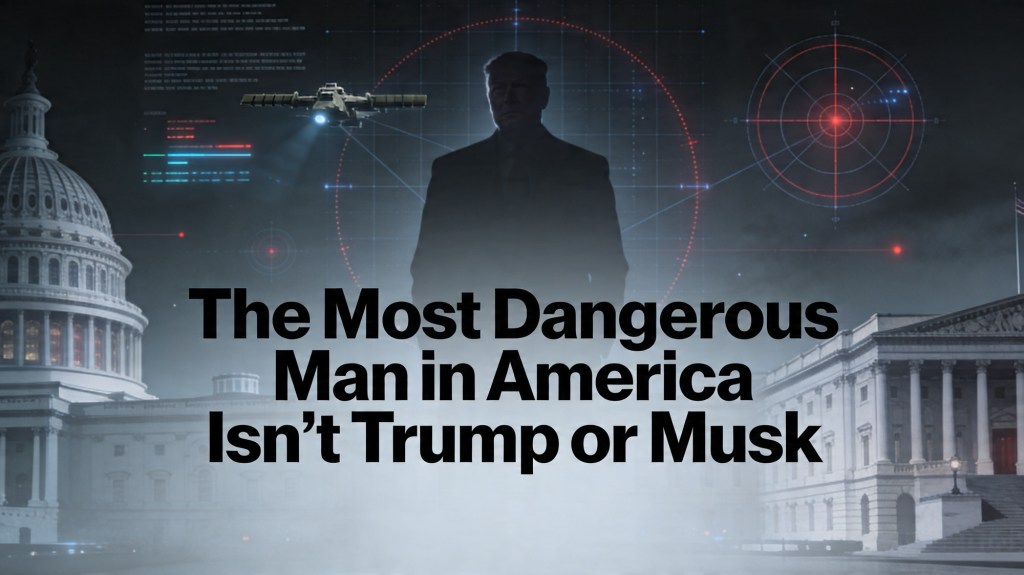
We keep getting hypnotized by loud villains. Trump on a stage, Musk shit-posting, the daily outrage loop. Meanwhile, one of the most dangerous people in the room almost never raises his voice.
Peter Thiel is not just “the PayPal guy” or a quirky billionaire with hot takes. He is building a full-spectrum system of control: political, digital, military, biological, and spiritual. A lot of it is already in place, inside the U.S. government, Israel’s war machine, health agencies, and the tech that will run the next few decades.
People need to see the machine.
1. The world Thiel wants
Thiel’s project makes sense once you see what he believes about power and who should wield it.
He has written that he no longer believes freedom and democracy can coexist. In his story, “capitalist democracy” only worked when:
- very few people could vote,
- equality was mostly talk,
- and capital quietly ran everything.
Once suffrage and equality expanded, he thinks the system turned into a vehicle for mediocrity and resentment. The public, in his view, is irrational and easy to mislead; mass politics gums up the plans of “superior” people.
He romanticizes founders and monopolies. A monopoly, to him, is what you get when a truly exceptional company has escaped competition and now has the freedom to shape the future. The pattern is clear: he prefers concentrated power in the hands of a few owners to dispersed power in the hands of many citizens.
Layered on that is a cold Christian hierarchy. Thiel leans on faith not as a call to care for the weak, but as a justification for order. He likes thinkers who say history is a war between civilization and chaos, and who see liberal ideals—rights, pluralism, equality—as symptoms of decay. In that frame, God wants strong fathers, strong churches, strong nations. The flock isn’t supposed to steer anything.
Then you add his transhumanism. Thiel funds:
- longevity labs trying to slow or reverse aging,
- biotech outfits focused on making biology more programmable,
- psychedelic + neuro-tech companies that want to “re-wire” behavior,
- and brain–computer-interface firms that sit directly on the cortex.
He talks about futures where humanity is transformed or superseded. He is comfortable with the idea that “humanity as we know it” might be sacrificed for a more “advanced” form. If you combine that with his hatred of equality, you end up with a picture of a small, upgraded overclass living longer, thinking faster, and steering everyone else—wrapped in a religious story that calls this “order.”
2. His people in the Trump–Vance government
Thiel doesn’t have to run for office. He seeds his worldview into government through people whose careers depend on him.
J.D. Vance
Vance is the most obvious example. Thiel brought him into Mithril Capital and into the Silicon Valley donor class. When Vance ran for Senate, Thiel dumped an outrageous amount of money into PACs backing him. That money made Vance viable. Thiel then helped smooth things over between Vance and Trump after Vance’s earlier criticisms. That pipeline ends in the vice-presidency.
Vance’s politics line up with Thiel’s:
- sneering at liberal democracy,
- cheerleading for a “strong state” that enforces Christian nationalist priorities,
- open talk about purging and refilling institutions.
He puts a religious-populist skin on Thiel’s anti-democratic skeleton.
David Sacks
Sacks has been inside Thiel’s orbit for decades. They wrote The Diversity Myth together. They got rich together. Now Sacks is, or has recently been, in the room for:
- AI regulation and deployment,
- digital-asset and crypto policy.
That means:
- where AI is allowed to run (war, policing, bureaucracy),
- and what kind of financial surveillance we build into the pipes
are being shaped by someone who shares Thiel’s contempt for “woke” anything and his instinct to protect founder power.
The second row
There’s also a quieter bench:
- a former Thiel Capital chief of staff in senior tech/defense roles,
- Jim O’Neill, ex-Thiel Foundation head, in a top job at HHS,
- Anduril alumni inside the Pentagon.
They control the boring but decisive stuff: procurement rules, contract choices, how aggressively to adopt “innovative” tools in sensitive areas. They are the ones who decide whether Thiel-world products become the default wiring of the state.
3. Palantir: the state’s nervous system
Palantir is Thiel’s most important instrument. It turns scattered data into a single view of people’s lives.
It pulls in:
- intelligence cables,
- call and internet metadata,
- travel records,
- bank and card transactions,
- social-media and open-source content,
- camera and license-plate data,
- police, court, and immigration files.
Inside Palantir, all of that becomes linked graphs and timelines. Analysts can click on a name or a phone and see where it appears, who it connects to, where it has moved. The system spits out “patterns of life” and risk scores that feed directly into targeting, surveillance, and raids.
Palantir is embedded:
- in the Pentagon and intelligence community, powering AI-assisted targeting and theater-wide intel;
- in ICE and DHS, where it runs what amounts to an “ImmigrationOS” for locating, tracking, and deporting migrants;
- in police departments and fusion centers, where it fuses local surveillance and records into protest maps and “hot lists.”
When an agency operates this way for long enough, it sees the world through Palantir’s lens. The company’s design choices become part of how the state decides who is dangerous and who is harmless.
4. Palantir in CDC, HHS, and FDA
Palantir is also deep inside health and food systems.
COVID exposed how broken U.S. public-health data was. HHS and CDC turned to Palantir to patch it. Their software became the backbone for HHS Protect and Tiberius, which tracked hospital beds, case counts, and vaccine shipments. That partnership hardened into a long-term CDC contract worth hundreds of millions to create a Palantir-run “Common Operating Picture” for public health. Now, when CDC staff look at outbreak maps, hospital capacity, and supply chains, they do it through Palantir dashboards.
At FDA, Palantir has contracts to help analyze:
- drug-safety and efficacy data, especially for cancer drugs,
- and food-supply disruptions that might trigger shortages.
So Thiel’s company sits on:
- war targeting,
- immigration enforcement,
- protest monitoring,
- pandemic and outbreak data,
- drug-safety analytics,
- food-supply warnings.
That’s an obscene amount of leverage for any one private firm, let alone one anchored in Thiel’s worldview.
5. Anduril: automated borders and bases
Anduril is the physical edge of his stack. Its towers, bristling with sensors, watch the southern border and base perimeters. The software classifies movement—person, animal, vehicle, drone—and pushes alerts to operators. In the counter-drone space, Anduril’s Lattice platform is being standardized as common command software across services.
Government contracts give Anduril:
- a guaranteed revenue stream in the billions over a decade,
- embedded systems at borders and bases,
- and a seat at the table on what “normal” looks like in modern security operations.
That means the logic written into Anduril’s code—what counts as a threat, how quickly to escalate, how much human review to require—becomes the default logic of the state in those zones.
6. Brain-tech and biological control
Thiel’s money is also sitting at the interface between brains and machines.
He funds Blackrock Neurotech, which makes implants that have been put into dozens of human brains, decoding neural signals so people can move a cursor or a robotic arm just by thinking. He backs companies that blend psychedelics with neurofeedback and potentially BCIs, promising to rewire thought patterns and emotional responses.
Right now, we see this in clinical and experimental settings. In the context of his broader project, it’s easy to imagine the next steps:
- BCIs and neuro-protocols for elite soldiers and intelligence operators, to keep them “focused” and “resilient”;
- similar setups for key civilian workers in finance, tech, and government;
- intrusive “treatments” for prisoners or “radicalized” individuals to align them with what the system expects.
That takes his ideas about hierarchy and control right inside the nervous system.
7. Digital money as a pressure point
Money is increasingly digital, trackable, and programmable. Thiel’s ecosystem is well-placed to shape the rails.
As:
- more payments move online,
- identity gets more tightly tied to accounts,
- and regulators lean on AI to detect “suspicious” activity,
the ability to punish people without arresting them grows. If your risk score trips some threshold in a Palantir-like system, you can find your bank stalling transfers, freezing accounts, or quietly closing doors in your face.
For a regime shaped by Thiel’s thinking, financial systems become a tool:
- to quietly wreck lives of opponents,
- to reward loyalty,
- to make “no buying, no selling” a software setting, not a biblical metaphor.
8. Gaza: the demo version
Gaza shows what happens when this stack plugs into a place with no rights.
During the recent escalation, Israeli intelligence used AI systems like Lavender and Gospel to build mass target lists from phone metadata and social networks. Those systems marked people and homes for bombing. The collateral-damage thresholds were high. The process was industrial.
Palantir announced a strategic partnership with Israel’s Ministry of Defense and has been proud of its role in “supporting Israel.” UN experts and journalists have raised serious concerns that Palantir’s platforms are part of the targeting and analysis backbone in this war.
When Thiel was asked about this, he said his bias was to “defer to Israel” and that the IDF was “in the right.” No hesitation, even as casualty numbers soared and accusations of war crimes mounted.
Gaza is a live-fire test bed for:
- dense, AI-driven surveillance;
- automated target selection;
- the use of data to manage and punish an entire population.
Once those tools and doctrines are normalized there, they don’t stay there. They get exported, adapted, and sold.
9. Epstein: the company he keeps
The Epstein story matters because it shows the circles Thiel is comfortable in.
After Epstein’s conviction, Thiel still kept up a long relationship with him. Calendars and emails show years of meetings and thousands of messages between them. Epstein moved tens of millions into Thiel-linked funds. They talked deals, politics, and big ideas. Reports on their exchanges note a shared contempt for democracy and a shared interest in eugenic thinking.
We don’t have public proof that Thiel literally bought Epstein’s blackmail archive. We do have proof that Thiel knowingly socialized and did business with a convicted trafficker whose entire game was compromising powerful men, and that he now builds technology that hands those same kinds of men a much larger, more respectable, more automated lever over the rest of us.
Epstein ran a filthy little control network based on sex and shame. Thiel is helping build a cleaner-looking version based on data and code.
10. Already here, not future fiction
None of this is just on PowerPoints.
Right now:
- Palantir-based systems are used in immigration enforcement to plan raids and deportations.
- Police tied into Palantir and similar platforms have tracked protestors and activists.
- Anduril’s towers are watching the U.S. border and feeding alerts based on their classifications.
- Gaza has been turned into a laboratory for AI-assisted war, with civilians dying in strikes moved along by software.
- CDC and FDA depend on Palantir for major parts of their data work, from disease surveillance to drug safety and food-supply issues.
The machine exists. It is live. The knobs may not be turned as far as they could be, but the wiring is there.
11. Where this heads if no one fights it
Follow the logic of his beliefs and the tools he has already put in place, and the destination is ugly.
Elections continue, but real power sits in an executive that governs through emergency and data. Civil servants who used to act as a brake on political insanity are replaced with loyalists from Project 2025–style lists. Agencies run on software built by Palantir and Anduril, and staffed by people who take Thiel’s contempt for democracy as common sense.
People are modeled as nodes and scores. Your ability to move through the world—to work, travel, bank, rent, get treated, organize—depends on favor from systems you never see, designed and tuned by people you never voted for. Money is so tightly tied to identity and risk modelling that being labeled “unsafe” or “unreliable” quietly kills your options. A small overclass, juiced by longevity and neuro-tech, lives longer, healthier, and more insulated lives and tells itself it deserves it.
All of this is wrapped in a story about “saving civilization,” “restoring order,” and “bringing faith back.” The story gives cover. The tech does the work.
If this thing reaches full size, there isn’t going to be a press conference or a red line where everyone suddenly realizes we crossed over. It will arrive the way it’s already arriving: contract by contract, dashboard by dashboard, law by law, inside systems nobody voted for and almost nobody understands.
One morning you wake up and the people you love are nothing but scores in a database owned by men like Peter Thiel, and the systems that decide whether you can move, work, speak, or eat are too deep in the walls to rip out without bringing the whole house down. That’s the future he’s buying his way toward.
The only real question left is how many of us are going to keep pretending this is just “innovation” while the lights go out.
Stay Curious.
Sources
- Peter Thiel’s own writing on democracy and capitalism:
- Thiel’s funding of J.D. Vance and role in his rise:
- Palantir’s work with the Pentagon, ICE, CDC, HHS, and FDA:
- Anduril’s border and defense contracts:
- Thiel’s investments in Blackrock Neurotech and psychedelic/neuro-tech ventures:
- AI-driven targeting in Gaza (Lavender, Gospel) and Palantir’s ties to Israel’s Ministry of Defense:
- Thiel’s post-conviction relationship with Jeffrey Epstein:
- The New York Times — “Peter Thiel Is Latest Billionaire Said to Have Met With Jeffrey Epstein”
- The Wall Street Journal — “Inside Jeffrey Epstein’s Circle”
- The Wall Street Journal — “How Jeffrey Epstein Tried to Tap Into Trump’s Circle”
- Wired — “Epstein Files Reveal Peter Thiel’s Elaborate Dietary Restrictions”
- The Nation — “What Peter Thiel Saw in Jeffrey Epstein”
 A Curious Stack
Leave a comment