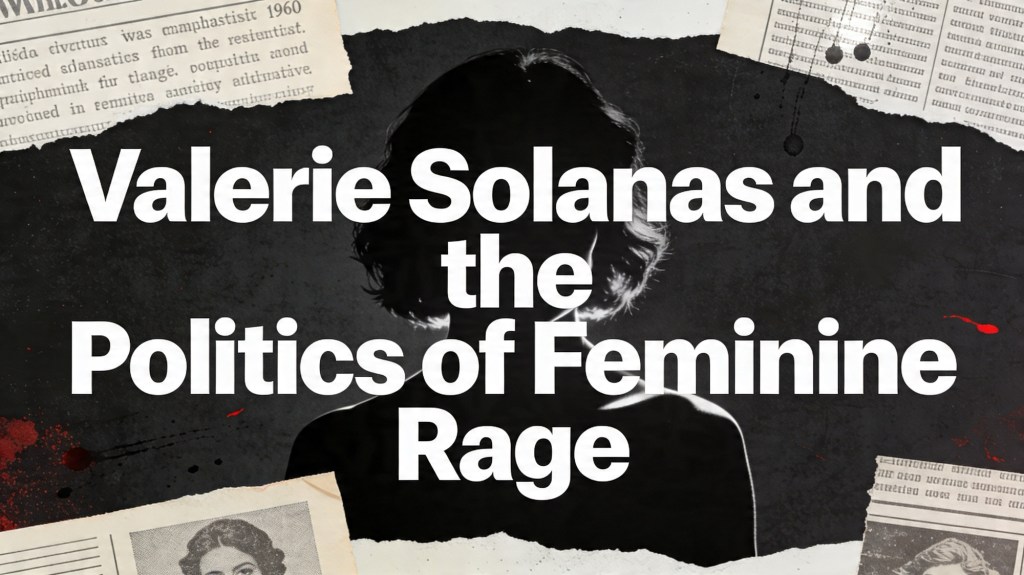
There are some women history allows to be angry.
Then there are women it marks as dangerous the moment their anger stops being eloquent, useful, or easy to domesticate.
Valerie Solanas was one of those women.
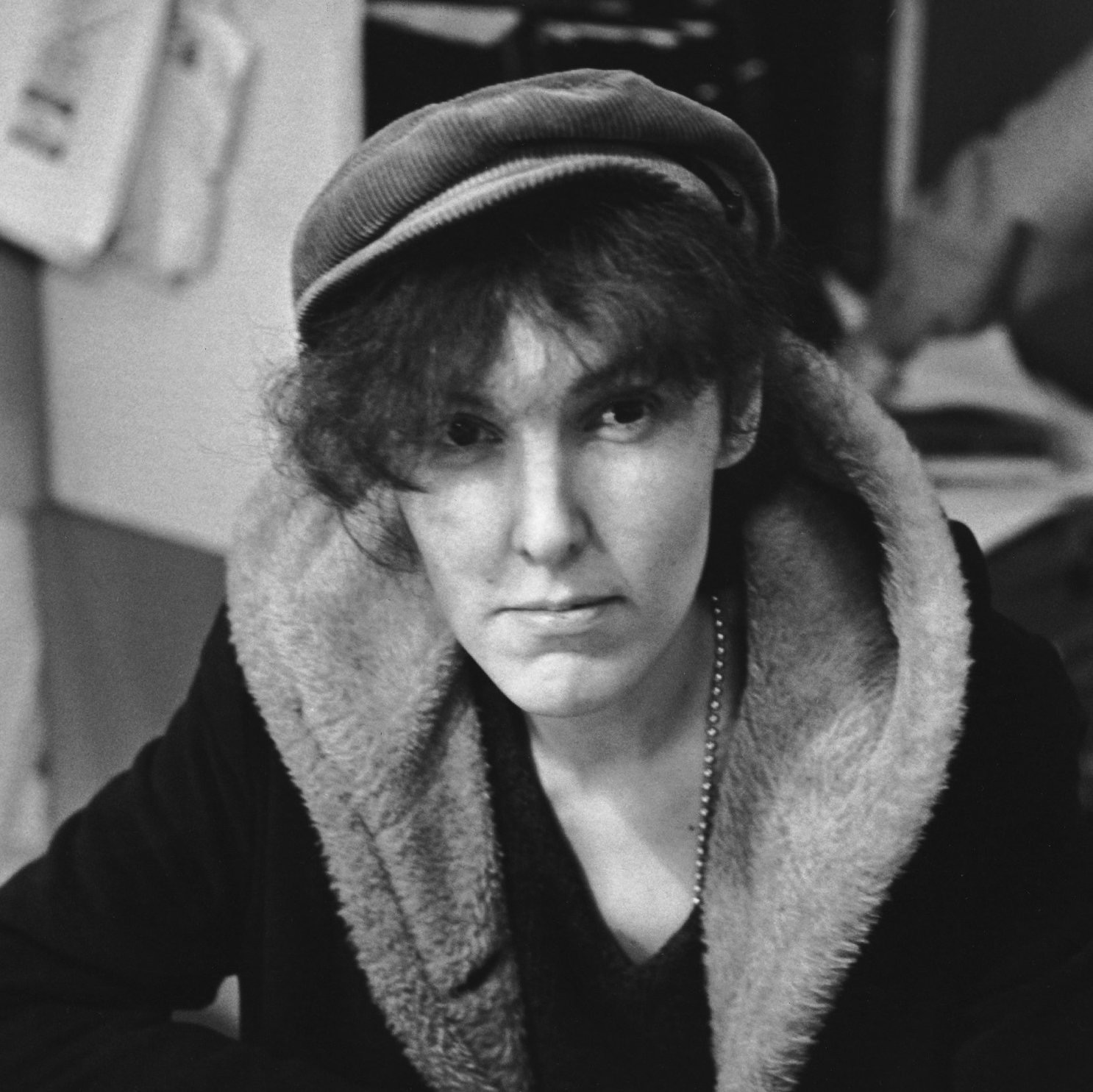
She was born in 1936 in New Jersey and lived a life marked by instability, poverty, abuse, intellectual sharpness, alienation, and refusal. She was a writer, a radical feminist, and a woman who moved through the world as if she already knew its promises were fraudulent. She attended college, wrote fiercely, drifted through sex work and economic precarity, and spent years trying to get her work taken seriously in a culture that had little interest in difficult women unless they could be turned into spectacle.
Most people know her for one thing: in 1968, she shot Andy Warhol.
That fact has followed her name ever since. It is the headline that swallows everything else. And while it cannot be ignored, it has also made it easier to dismiss her as nothing more than madness and violence, rather than confront the deeper political charge of what she wrote.
⸻
More than a scandal
Before Valerie Solanas became a cultural ghost, she was trying to be read.
She wrote a play called Up Your Ass. She circulated her work. She wanted entry into a literary and artistic world controlled, as most worlds were and are, by male approval. She crossed paths with Warhol in part because she was trying to get her writing seen.
Then came SCUM Manifesto.
Published in 1967, it remains one of the most incendiary texts in feminist history. Not because it asked for equality. Not because it politely critiqued sexism. But because it rejected the whole structure.
Solanas was not arguing that men needed to behave better.
She was arguing that the entire system was rotten.
⸻
What the manifesto actually does
At its core, SCUM Manifesto is an attack on patriarchy as a total order.
Not just men as individuals. Not just sexism as attitude. The whole machine.
Solanas goes after:
- Government
- Capitalism
- Wage labor
- The family
- Sexual norms
- Male authority
- Cultural respectability
- The idea that women should adapt to any of it
That is part of why the text still unsettles people.
Its language is extreme. Its fantasies are violent. Its biological claims are deeply flawed. Its political vision is not something to romanticize or revive. But underneath all that is a ferocious insistence that women are not obligated to keep negotiating with structures built on their subordination.
⸻
Why she still feels current
This is why Solanas still lands with such force now.
Not because she gave us a blueprint.
Because she gave voice to a kind of rage that public life still does not know what to do with.
We live in a culture that likes women’s anger only when it is:
- Articulate
- Marketable
- Inspirational
- Safely symbolic
- Detached from real political threat
The minute rage becomes unpretty, excessive, or unwilling to soothe anyone, it gets called unstable, toxic, irrational, or dangerous.
Solanas belongs to that unpermitted category.
She did not want to be empowering.
She did not want to be likable.
She did not want to make her wounds educational for other people.
That is part of why she remains unbearable.
⸻
The current political landscape
Read against 2026, Solanas feels less like a historical oddity and more like a signal flare from a world we never actually left.
Women’s bodily autonomy is still under assault. Reproductive rights remain a political battlefield. Federal pressure and state-level fights continue over abortion access, medication abortion, ballot measures, and the basic question of whether women can govern their own bodies without interference from the state.
That matters here because Solanas understood patriarchy as structural.
She was not talking about isolated bad men.
She was talking about systems that organize power through law, labor, medicine, and control. And when those systems keep showing up in the headlines, her fury stops looking random and starts looking diagnostic.
Then there is the culture of monetized misogyny.
The continued prominence of figures like Andrew Tate, even amid reopened investigations and ongoing scrutiny around abuse allegations, tells you something ugly and obvious about the present moment: contempt for women is not fringe. It is profitable. It is platformed. It is algorithmically fed to boys and men as identity, entertainment, and grievance.
Solanas understood that too, in her own distorted way.
She understood that misogyny is not a glitch in the system.
It is one of its engines.
⸻
Feminine rage is not an aesthetic
That phrase gets thrown around constantly now: feminine rage.
Usually it means a mood board. A playlist. A caption. A marketing tone.
But Solanas points to something much darker than that.
She represents rage that is:
- Not asking to be validated
- Not interested in healing as a brand
- Not trying to be admired
- Not translating itself into acceptable language
- Not concerned with whether anyone finds it elegant
That is why she still disrupts.
She reminds us that rage is not always redemptive. Sometimes it is corrosive. Sometimes it is ethically compromised. Sometimes it is what comes after too much humiliation has been dressed up as normal life.
And that is where she becomes politically difficult in a useful way.
Because the question is not whether Solanas was right. In many ways, she was catastrophically wrong.
The question is this:
What kind of society produces this level of female fury and then acts shocked by its existence?
⸻
Her obsession with work
One of the strangest things about SCUM Manifesto is how much it cares about labor.
Solanas hated the money-work system. She imagined automation destroying degrading labor and freeing women from dependence, drudgery, and service.
That sounds oddly contemporary.
Now we are living through a moment when automation and AI are sold as liberation, while care work remains underpaid, invisible, and disproportionately feminized. Administrative and support roles are treated as expendable. The labor of keeping people alive is still taken for granted.
So even here, in one of the text’s stranger corners, Solanas was pressing on something real:
- Who benefits from technology
- Who gets displaced
- Who keeps doing the intimate labor
- Who is told sacrifice is natural
That part still cuts.
⸻
What to do with Solanas
Valerie Solanas should not be turned into a feminist saint.
She should not be cleaned up, glamorized, or used as a mascot for violence.
But she also should not be reduced to a punchline, a pathology, or a footnote in Andy Warhol’s story.
She matters because she forces a confrontation.
She forces us to look at female rage when it refuses charm.
She forces us to ask what happens when women stop believing reform will save them.
She forces us to reckon with the fact that power always prefers wounded women to angry ones.
And she still matters because our political culture keeps proving the conditions she raged against were never fully buried.
⸻
The thing she exposes
So no, Valerie Solanas is not a heroine.
She is not a guide.
She is not a model.
She is something harder to absorb than any of that.
She is what feminine rage looks like when it has passed the point of asking permission.
In a world where women’s autonomy is still debated like a public inconvenience, where misogyny is packaged as content, and where domination keeps getting rebranded as common sense, Solanas remains unsettling for one reason above all:
She refused to mistake survival for consent.
⸻
Stay Curious.
⸻
Sources
https://en.wikipedia.org/wiki/Valerie_Solanas
https://www.biography.com/artists/andy-warhol-valerie-solanas-shot
https://www.ebsco.com/research-starters/history/valerie-solanas
https://en.wikipedia.org/wiki/SCUM_Manifesto
https://www.ebsco.com/research-starters/literature-and-writing/scum-manifesto
https://www.hrw.org/news/2026/04/08/trump-administration-wields-new-threat-to-reproductive-rights
https://reproductivefreedomforall.org/news/six-reproductive-freedom-storylines-to-watch-in-2026/
https://reproductiverights.org/news/u-s-repro-watch-1-20-26/
https://www.bbc.com/news/articles/c17veqk90nno
 A Curious Stack
Leave a comment