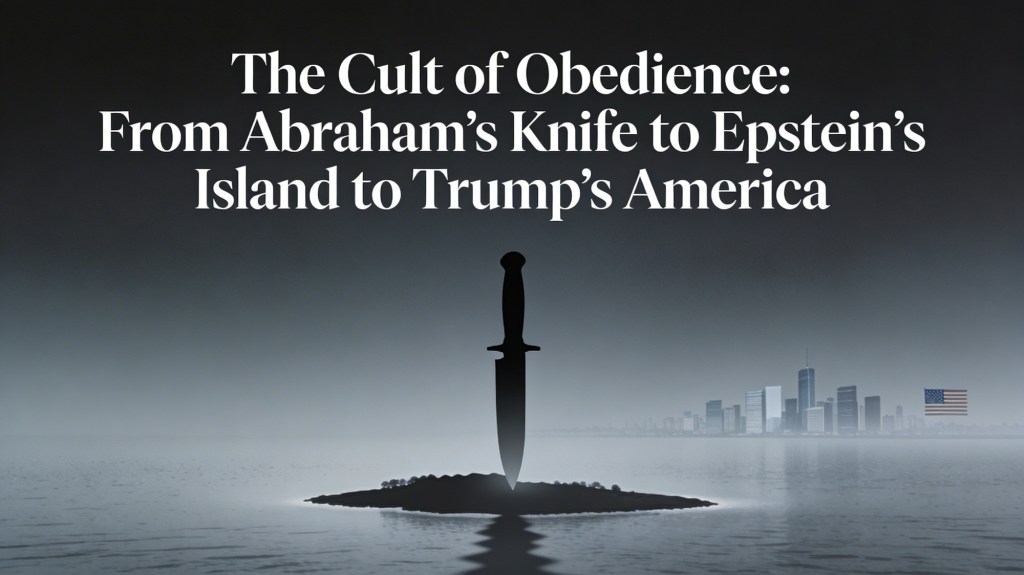
What if the darkest thing about this moment is not that we have suddenly become “satanic,” but that we have stayed exactly the same?
What if Jeffrey Epstein’s island, Israel’s deep politics, and Trump’s Christian nationalist project are not separate freak events, but three faces of a very old religion that runs on obedience and sacrifice, now secular and fully weaponized?
That is the network I want to map here.
⸻
I. The old religion: obedience and sacrifice
In the earlier “cult of obedience” idea, the core claim was that Abrahamic religion runs on a simple pattern:
- a higher authority has the right to demand anything, even your child
- the highest virtue is obedience, even when it violates your own moral sense
- someone’s suffering can be rebranded as “sacrifice” if it serves a “higher good”
Three central stories make that pattern vivid.
Abraham and Isaac. Abraham is praised not for protecting his son but for being willing to kill him if God says so. The raised knife over Isaac is the pure image of obedience. The ram appears at the last minute, but the emotional lesson is that a good man will override love and instinct when the higher voice commands it.
Job. Job is praised for enduring catastrophic, undeserved suffering without cursing God. When he demands answers, he is rebuked. Doubt and protest are treated as spiritual failure. The “hero” is the one who accepts pain rather than insist that it make sense.
The crucifixion. Jesus is praised for submitting to execution. One innocent death is declared necessary for everyone else to be forgiven. The suffering of the blameless becomes the currency that buys redemption for the guilty.
Over centuries, these stories train certain reflexes:
- obedience is holy, even when it hurts
- questioning authority is suspect, even when authority is clearly wrong
- suffering can be rewritten as meaningful if someone higher up says it serves a plan
Once that logic is baked into a culture, it becomes an operating system. It does not stay confined to churches and synagogues. It leaks:
- into corporations that expect people to “take one for the team”
- into states that send people to die for “the nation”
- into intelligence services that justify abuses in the name of “security”
- into private networks like Epstein’s, where some lives are simply treated as expendable
At the core is a cult of obedience that runs on the sacrifice of people who do not get to say no.
⸻
II. Epstein’s world as a secular priesthood
If you strip away the tabloid gloss and look at structure, Epstein’s world looks less like random depravity and more like a small, tightly run religion.
Epstein was not just rich; he was a mediator of access. He connected billionaires, politicians, academics, and royalty across New York, Washington, London, Paris, and Tel Aviv. He controlled introductions, money flows, and invitations into rooms most people never see. People came to him to cross thresholds:
- into new social and financial circles
- into deals and opportunities otherwise closed to them
- into a feeling of being above consequence
That is priest energy. He stood at the gate between the ordinary and the inner sanctum and decided who got through.
His spaces functioned as temples:
- the Manhattan townhouse with cameras and hidden rooms
- the private island
- the New Mexico ranch
- the jets and gated compounds
These were set apart environments where normal rules softened or disappeared. Crossing those thresholds meant entering a different moral universe. Law became flexible. Age became ambiguous. Consent became something that could be assumed, bought, or staged. The unspoken command inside these spaces was simple: this is how things work here. If you cannot accept that, you are not one of us.
Belonging was sealed through ritual. For powerful men, the rituals were “massages,” parties, and sexual encounters that blurred lines between legal and criminal, adult and underage, consensual and coerced. For girls and young women, the rituals were the slow steps of recruitment and grooming:
- being spotted and flattered
- being offered money or opportunity
- being transported and presented
These were initiations. Watch something happen and stay silent, and you cross a line. Participate, and you cross a deeper one. Each step into transgression binds you more tightly to the group, because your own shame and vulnerability become part of what traps you. In ordinary religion, sacraments mark belonging. In Epstein’s circle, the sacrament was complicity.
Every sacrificial religion has offerings. Here, the offerings were:
- poor and working‑class girls
- migrants and runaways
- young women already at the edges of protection
Their bodies and futures were consumed so that elites could enjoy access without consequence, so Epstein could gather leverage, and so the inner circle could bond over the feeling of existing above the law. Their trauma was the fuel that kept the machine running.
There were no horns or pentagrams in that logic. It was a cult of power that ran on human sacrifice.
⸻
III. The Israel layer: sacred state, dirty work
Now add the Israel layer. Not as a cartoon where one foreign service controls everything, but as a concrete example of how sacrificial logic intersects with real states, diaspora donors, and intelligence cultures.
Investigations show dense ties between Epstein, major pro‑Israel donors, and Israeli political and security figures. His main patron, Leslie Wexner, co‑founded what has been called the “Mega Group,” a cluster of ultra‑wealthy Jewish businessmen whose philanthropy and influence have been tightly bound up with supporting Israel and Zionist projects. Through Wexner, Epstein became involved with the Wexner Foundation, which funds leadership programs in Israel and the United States, including fellowships at Harvard that groom future American and Israeli officials.
Reports describe Epstein meeting or hosting figures like former Prime Minister Ehud Barak and intersecting socially and financially with other Israeli political and business elites. Those relationships created a bridge between American money, Israeli politics, and a particular vision of Jewish power and security.
On the intelligence side, former officer Ari Ben‑Menashe has claimed that Epstein and Ghislaine Maxwell ran a sex‑blackmail operation linked to Israeli foreign intelligence, echoing longstanding reporting about Ghislaine’s father, media tycoon Robert Maxwell, and his alleged work with those services. A declassified FBI memo mentions an informant’s belief that Epstein was trained as a spy and co‑opted as an asset, though the document does not treat that as proven fact. When new records surfaced in 2026, Israeli officials and former intelligence leaders, including Netanyahu and ex‑Mossad heads, quickly and firmly denied that Epstein ever worked for them.
So we end up with a three‑sided picture:
- clear links to a pro‑Israel donor and leadership ecosystem
- recurring but disputed claims of sexpionage and kompromat
- strong official denials and a tendency in mainstream coverage to skirt this angle
You do not need to settle every claim to see how the underlying pattern works.
For many, Israel is not just a country. It is a redemptive project:
- for Jews, a refuge after the Holocaust and centuries of persecution
- for Christian Zionists, a key stage in prophecy
- for Western strategists, a crucial outpost in a contested region
Once a state is treated as sacred, sacrificial logic becomes normal. Palestinian lives and neighboring civilians are framed as “tragic but necessary” losses in the name of security and survival. Critics can be branded traitors or antisemites. Emergency becomes permanent.
Place an Epstein‑style operation near that world and the fit is easy to see. A sex and leverage machine that can gather compromising material on powerful men. A donor network convinced it is defending a sacred project. Security institutions that see morally dirty work as part of their job. In that mix, vulnerable bodies again become offerings. The benefits are access, pressure, and influence over key players. The story that justifies it is the same one used elsewhere: protection of “our people,” survival in a hostile world, national security.
This is not proof that “Israel did Epstein.” It is evidence that when you fuse a sacred state with an obedience‑and‑sacrifice imagination, you build a world where using people as tools for leverage feels like part of the job.
⸻
IV. Christian nationalism and the American altar
Now turn back to the United States and the rise of Christian nationalism under Trump. The same operating system is being activated here as an engine for authoritarian change.
Christian nationalism is not just devout people who vote. It is a specific ideology that says:
- the United States was founded by and for a certain kind of Christian
- the nation has a special covenant with God
- “true Americans” are those who live inside a conservative Christian cultural order
In that story, secular people, Muslims, Jews, liberal Christians, queer and trans people, immigrants, and many women who assert their autonomy become threats to the covenant. Political control is framed as a religious duty. Laws, schools, and public symbols are supposed to privilege one religious vision and treat others as marginal or suspect.
Trump has become the central vessel for that project. He tells Christian audiences that government, media, and “globalists” are waging a war on them, and that attacks on him are really attacks on their faith. He promises to “end the war on Christians” if they return him to office. In one notorious line, he said that after four more years “you will not have to vote any more,” suggesting that their dominance will be locked in so firmly that democratic struggle becomes unnecessary.
Key Christian nationalist pastors and activists describe him as “anointed,” a modern Cyrus or David, a man whose obvious flaws are recast as proof that God is using him. In that frame:
- loyalty to Trump becomes loyalty to God and to the “real” America
- criticism of him becomes a kind of heresy
Behind the rhetoric sits a thick stack of plans. A project like the widely discussed 2025 blueprint, created by conservative think tanks and Christian right networks, outlines how a future administration could:
- massively expand presidential control over the federal bureaucracy
- reclassify and purge tens of thousands of career civil servants
- replace them with ideologically screened loyalists
- reshape agencies to enforce a narrow religious and cultural program
It pairs that structural shift with an agenda to roll back reproductive rights, LGBTQ rights, and church–state separation while insisting that government policy follow a particular reading of Christian scripture.
Legal scholars, democracy advocates, and many faith‑based civil rights groups warn that such a plan would strip away checks and balances, politicize the civil service, and effectively install a Christian nationalist faction in long term control of the state. It would keep the outer shell of elections while hollowing out meaningful pluralism.
In sacrificial terms, this project clearly names who will pay the price:
- queer and trans people, in lost safety, healthcare, and legal personhood
- women and pregnant people, in forced continuation of pregnancies and the loss of bodily autonomy
- religious minorities and non‑believers, in second‑class status
- dissenting Christians, in marginalization inside their own tradition
Their suffering is presented as necessary to “restore” America to God. Obedience to this program is preached as faithfulness. Resistance is framed as rebellion against both God and nation.
⸻
V. One network, one operating system
Put these pieces next to each other and the same pattern appears in different costumes. Epstein’s island. Israel’s sacred statecraft. Trump’s Christian nationalist push. Different actors, slogans, and symbols. One operating system.
Across them, you see the same moves:
- a chosen group convinced it is uniquely loved or chosen by God or history
- an anointed leader or inner ring claiming to speak for that higher power
- a class of people treated as raw material to be sacrificed so the chosen can remain safe, pure, or in charge
In the ancient stories, it is Israel and its enemies, or the righteous and the scapegoat. In modern Israel, it is Jewish citizens at the core and Palestinians as problems to be contained, displaced, or destroyed. In Epstein’s world, it is powerful men at the center and vulnerable girls as consumables. In Christian nationalism, it is white conservative Christians as “real Americans” and everyone else as either guests or enemies.
You also see the same anatomy of authority. Patriarchs and kings in scripture rule by divine mandate. Security states claim special powers above law to keep people safe. Epstein acts as a priest‑king of his own hidden realm. Trump is cast as God’s instrument whose authority extends beyond normal moral and legal limits.
In each case, followers are pressed to trust the leader more than their own eyes and conscience.
At the root is the same idea of sacrifice. Someone has to pay so that others can be secure, clean, redeemed, or blessed. In one setting that someone is a lamb or a firstborn son. In another it is a village under bombs or a population under siege. In another it is a girl on a massage table who cannot safely say no. In another it is a pregnant person forced into childbirth or a queer child stripped of rights.
Different stories. Same altar.
⸻
VI. Why “satanic” misses what matters
When people see this cluster of horrors, they often reach for “satanic.” Epstein’s operation feels satanic. Mass death in Gaza feels satanic. Crosses at rallies that call for purges feel satanic.
The instinct is understandable. The violence, hypocrisy, and coldness feel like more than ordinary human failure. But the “satanic” label is also a way of pushing the problem outside of ourselves.
Calling it satanic makes the horror feel foreign rather than familiar. It suggests that something monstrous has invaded our world, instead of acknowledging that our world was built with sacrificial stories from the beginning. It allows respectable religion to stay clean. If Epstein is satanic, then churches, synagogues, Christian Zionists, Christian nationalists, and patriotic ceremonies can present themselves as the opposite, instead of asking how deeply their own imagination has been saturated with obedience and sacrifice.
It also tempts us toward magical solutions. If Satan is the problem, then exorcism and spiritual warfare are the answer. There is less pressure to dismantle institutions, refuse unjust orders, break secrecy, or admit the ways our own communities have treated others as expendable.
The harder truth is that none of this needs a devil. It needs human beings who have learned that obedience is the highest virtue and that someone else’s suffering can be redeployed as meaning. It needs structures that reward people for acting on those beliefs.
Epstein’s network, Israel’s sacred politics, and Trump’s Christian nationalist project are not accidents that broke away from our moral tradition. They are what it looks like when that tradition’s darkest structure expresses itself under modern conditions of wealth, media, surveillance, and state power.
⸻
VII. Stepping away from the knife
If this is a cult, leaving it is not about fleeing to the desert. It is about refusing the logic wherever you stand.
It starts with refusing obedience when obedience requires you to ignore obvious harm. Staff choose not to look away. Officials choose not to sign. Believers choose not to chant along when leaders ask them to trade someone else’s life, safety, or freedom for an abstract cause.
It means deciding that:
- no “anointed” leader outranks your basic sense that a human being is being treated as disposable
- no sacred nation or holy project justifies treating particular bodies and communities as fuel
It continues with refusing sacrifice as a moral argument. When you hear “this is tragic but necessary,” you slow down. Necessary for whom. Who decided. Why that group, and not yours. You stop letting “collateral damage” function as a polite phrase for “we chose them to suffer so we do not have to.”
Finally, it looks like building spaces that do not run on sacrifice. Workplaces where status never entitles someone to another person’s body or silence. Faith communities that refuse nationalism and drop the romance of suffering as an ideal. Political movements that will not buy a win at the price of turning whole categories of people into targets.
Because this really is a network, and it really is old.
Abraham on the mountain. Girls on an island. Children under rubble. Queer kids on legislative floors. Crowds told that if they obey hard enough, they will no longer have to vote.
Different names. Different flags. The same altar.
The work now is not to rename it “satanic,” but to recognize it as the sacrificial religion we have been practicing all along and to finally, deliberately, step away from the knife.
⸻
Stay Curious
⸻


 A Curious Stack
Leave a reply to M3W Cancel reply