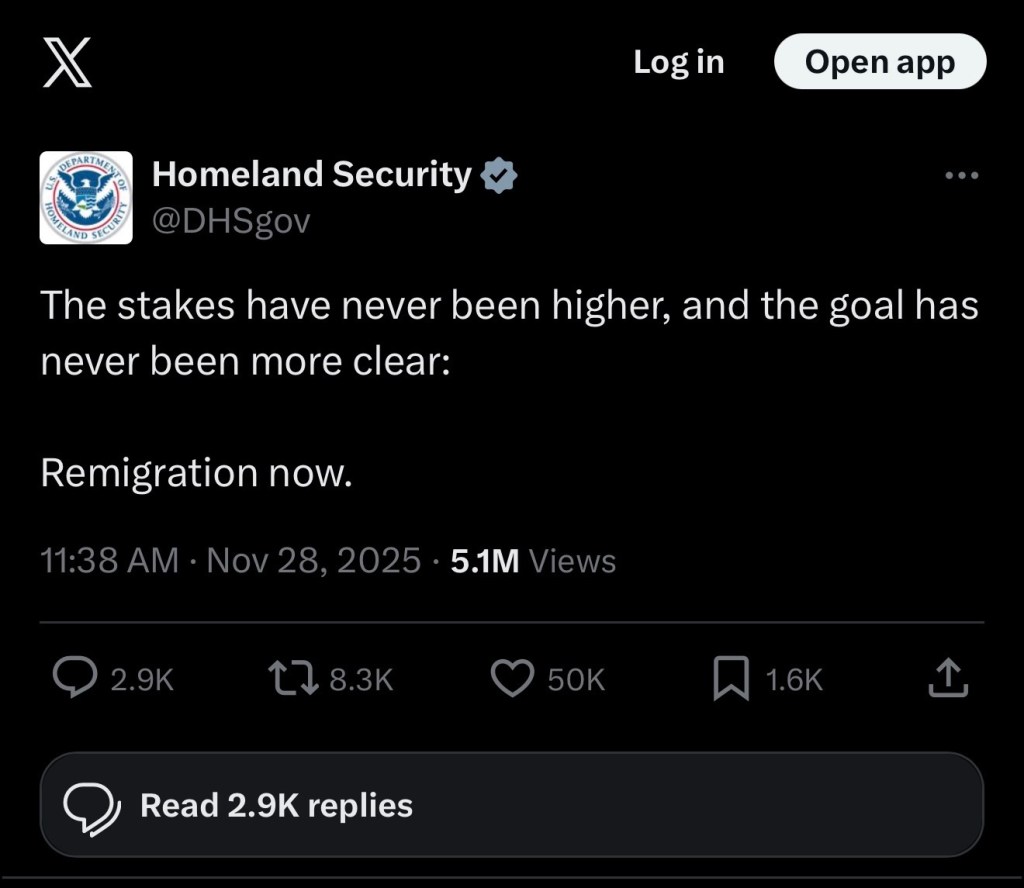
The term “remigration” in the DHS post pictured above is loaded political language, not just a neutral synonym for “returning home,” and its use signals a hard turn toward mass exclusion and expulsion as a central goal of U.S. immigration policy. Understanding where this word comes from, and how extremists have used it, is crucial to interpreting a message like “Remigration now” coming from the agency that controls the machinery of immigration enforcement.
⸻
what “remigration” means
In a narrow, literal sense, “remigration” can describe people moving back to a country they previously left, such as migrants who voluntarily decide to return after working abroad. DHS officials lean on this dictionary meaning when they frame “remigrate” as encouraging people without legal status to leave “on their own” through self‑deportation channels or voluntary return programs.
Over the last decade, however, “remigration” has become a flagship slogan for European far‑right and identitarian movements that want to reverse demographic change by expelling large numbers of migrants and their descendants. In that context, it is promoted as a solution to the “Great Replacement” conspiracy theory, which imagines white majorities being intentionally “replaced” and calls for removing people of color—sometimes even citizens—to restore a preferred ethno‑national balance.
⸻
DHS, X, and the “remigration” uproar
In 2025, the official DHS account on X posted a sparse message urging immigrants to “remigrate,” with a link to a federal self‑deportation or “voluntary return” app, triggering backlash from civil‑rights advocates, immigrant communities, and extremism experts. Critics argued that using this particular word, rather than generic bureaucratic language like “voluntary departure,” effectively echoed the vocabulary of white‑nationalist and neo‑fascist circles.
DHS leaders defended the post by pointing to dictionary definitions and insisting that the intent was simply to encourage undocumented people to use official channels to leave the country. The controversy has persisted, though, because the agency has not grappled publicly with the term’s extremist history, and because the message landed in a broader context of aggressive new crackdowns, halted asylum decisions, and rhetoric from President Donald Trump about pausing or reversing large swaths of migration.
⸻
how extremists weaponize the term
Researchers who study radicalization describe “remigration” as a strategic euphemism: a technical‑sounding word used to make extreme racial projects sound like ordinary policy proposals. Far‑right conferences and manifestos have sketched out “remigration plans” that include deporting long‑term residents, revoking citizenship from people with immigrant backgrounds, and coercively relocating communities considered “incompatible” with the dominant culture.
Because the word can be heard in two ways—bland and bureaucratic on the surface, genocidal to those already steeped in Great Replacement ideology—it functions as a dog whistle. When a powerful state agency repeats it without clear rejection of its extremist meaning, it risks validating those more radical interpretations and signaling that the door is open for policies approaching ethnic cleansing in everything but name.
⸻
reading “Remigration now” in the current moment
In the DHS post on X, the line “The stakes have never been higher, and the goal has never been more clear: Remigration now” moves beyond a dry informational notice and frames “remigration” as a historic mission. That sense of urgency mirrors the apocalyptic language used by Great Replacement ideologues, who cast demographic change as an existential emergency demanding immediate, large‑scale removals.
For undocumented people, mixed‑status families, and racialized communities, such a post suggests that the federal government may not only police future border crossings but also revisit who is allowed to remain, potentially on a mass scale. For observers tracking Trump‑era policies—halted asylum processing, re‑examination of green cards, and proposals to pause or reverse millions of admissions—the slogan “Remigration now” reads less as an isolated social‑media choice and more as ideological branding for an emerging program of reverse migration.
⸻
Stay curious.
⸻
sources
• CNN – “DHS issued a call to ‘remigrate.’ Here’s the history of the term often …” (explainer on the DHS post and expert concerns)
https://www.cnn.com/2025/10/19/us/remigrate-dhs-explained
• Collins‑style and encyclopedic overviews of “Remigration” (etymology and political usage)
https://en.wikipedia.org/wiki/Remigration
• Moneycontrol – “What does ‘remigrate’ mean? US homeland security department under fire over post on self‑deporta…”
• Political Research Associates – “‘Remigration’ is American for ‘Ethnic Cleansing’”
https://politicalresearch.org/2025/07/08/remigration-american-ethnic-cleansing
• SAN / Straight Arrow News – “DHS ‘remigrate’ post sparks debate over its definition and ties to extremism”
https://san.com/cc/dhs-remigrate-post-sparks-debate-over-its-defintion-and-ties-to-extremism
• Country Herald and similar coverage of backlash and protests over the DHS “remigrate” tweet
• InfoMigrants – “‘Remigration’: How a word threatens to change migration views in Germany”
• European Council on Refugees and Exiles / ISD reports on “total remigration” and anti‑migrant narratives
https://ecre.org/germany-far-right-remigration-meeting-provokes-anger-in-the-streets
• Social‑media and advocacy explainers highlighting the term’s Great Replacement roots
https://www.facebook.com/nowthisimpact/posts/
• International coverage of Trump’s late‑2025 immigration measures and asylum freeze
• Forbes – “Trump Post Hints At Stopping Legal Immigration To The United States”
• American Immigration Council – “Mass Deportation: Analyzing the Trump Administration’s Attacks on …”
https://www.americanimmigrationcouncil.org/report/mass-deportation-trump-democracy
• White House – “Protecting The American People Against Invasion” (2025 executive order text)

 A Curious Stack
Leave a comment