
introduction : the rhythm of history
History doesn’t repeat itself word for word — but it hums in familiar keys.
When people warn that America’s current political slide echoes Germany’s 1930s descent into dictatorship, the instinct isn’t hysteria. It’s memory doing its job.
In both cases, a charismatic strongman exploited chaos, fear, and bureaucracy’s blind spots. The uniforms and slogans differ, but the legal maneuvers and structural corrosion look unsettlingly familiar: the use of emergency powers, the consolidation of executive control, the purge of institutional neutrality, and the gradual militarization of domestic life.
Hitler turned these moves into a totalitarian machine. Trump, as of 2025, appears intent on testing how far the modern American system can bend before it breaks.

⸻
I. hitler’s playbook: legal dictatorship, built on paperwork
When Adolf Hitler became Chancellor in January 1933, Germany was a fragile democracy haunted by economic collapse and political violence. He didn’t seize power overnight — he legalized it.
- After the Reichstag Fire in February 1933, Hitler invoked Article 48 of the Weimar Constitution to suspend civil liberties and mass-arrest political opponents under the pretense of “national security.”
- Within a month, the Enabling Act passed — giving his cabinet power to enact laws without the Reichstag or President. That act became the constitutional foundation of Nazi dictatorship (Britannica).
- He then initiated Gleichschaltung, the “coordination” of every institution — states, courts, unions, media — under Nazi authority (USHMM).
- Civil servants were purged and required to swear loyalty to the Führer. Local governments were replaced or subordinated (Law & Liberty).
- Even internal policing became militarized. The SS and Gestapo blurred the line between civilian law enforcement and state security — an early warning sign of total control.
Hitler’s genius wasn’t raw force; it was bureaucratic capture. He weaponized legality itself.
⸻
II. trump 2025: legal brinkmanship and the american stress test
The United States in 2025 is not Weimar Germany. The Constitution remains, elections still occur, and pluralism persists.
But Trump’s second administration has systematically explored how far executive power can stretch inside a constitutional democracy without snapping it.
1. emergency powers as normal governance
- Trump has invoked national emergency authorities under the Defense Production Act to override environmental and labor regulations in the name of “energy independence.”
- In March 2025, he used that same framework to accelerate mining deals and bypass congressional oversight (Reuters).
- He has repeatedly threatened to use the Insurrection Act, a 1792 law allowing domestic troop deployment, to “restore order” in politically opposed cities (TIME).
Legal experts warn that these measures normalize permanent emergency — the same logic Hitler exploited (AP News).
2. militarization of domestic policy
- In August 2025, Trump invoked Section 740 of the D.C. Home Rule Act to federalize Washington D.C.’s police, claiming a “crime emergency.” Crime rates were actually lower than in 2019 (Wikipedia).
- Later, the administration deployed Texas National Guard troops to Chicago over state objections — a maneuver unprecedented in modern U.S. history (The Guardian).
- The Department of Defense was symbolically rebranded the Department of War, reinforcing a narrative that domestic dissent is a battlefield.
3. institutional capture
- The Rescissions Act of 2025 slashed funding for the Corporation for Public Broadcasting, the EPA’s climate division, and multiple oversight offices (Congress.gov).
- Loyalty testing has reportedly extended to U.S. attorneys, inspectors general, and senior civil servants (Reuters).
- Combined with a Supreme Court increasingly favorable to emergency-order jurisprudence (Reuters), the executive branch now faces fewer real checks than at any time in modern memory.
⸻
III. shared patterns across time
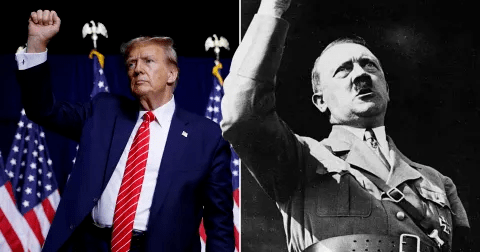
- Hitler used emergency decrees; Trump uses the National Emergencies Act.
- Hitler passed the Enabling Act; Trump rules by executive order and an empowered judiciary that often upholds them through its “shadow docket.”
- Hitler coordinated institutions under a single ideology; Trump has filled watchdog and judicial posts with personal loyalists while dismantling regulatory autonomy.
- Hitler monopolized the press; Trump defunds public broadcasting while using social media ecosystems as de facto propaganda channels.
- Hitler militarized domestic enforcement; Trump deploys National Guard units and reframes dissent as insurgency.
The pattern is mechanical, not identical. Normalize the emergency, centralize decision-making, blur the civil–military divide, erode oversight, and dominate information.
⸻
IV. what’s different — and what still matters
America still has safeguards that Germany in 1933 lacked.
Federalism disperses power, civil society is active, and opposition media exists.
But the danger today isn’t an outright fascist coup — it’s incremental authoritarianism: the slow legal drift where exceptional powers become permanent tools of governance.
When citizens get used to rule-by-decree, oversight loses oxygen. The Constitution doesn’t need to be abolished to become irrelevant; it only needs to be bypassed often enough that people stop noticing.
⸻
V. the warning lights
- Permanent emergency declarations quietly renewed each fiscal cycle.
- Federal troops used for political theater under “public safety” language.
- Courts fast-tracking executive orders with minimal scrutiny.
- Civil service purged and replaced with partisan loyalists.
- Public broadcasting defunded while state-aligned media rises.
These are the metrics of democratic erosion — subtle, procedural, and cumulative.
⸻
conclusion: the slow march
In 1933, Germans believed their institutions would contain Hitler. They underestimated the legal scaffolding of power — how fast rule of law can be twisted into rule by law.
In 2025, Americans risk the same complacency. The pageantry remains democratic, but the playbook leans authoritarian: endless emergencies, expanding executive authority, and shrinking accountability.
The United States still has time. But time isn’t a given. Every unchecked order, every silenced oversight body, every defunded watchdog pushes the line closer to the edge — until what’s left looks like legality but feels like control.
⸻
Stay curious.
⸻

 A Curious Stack
Leave a reply to pk 🌎 Cancel reply