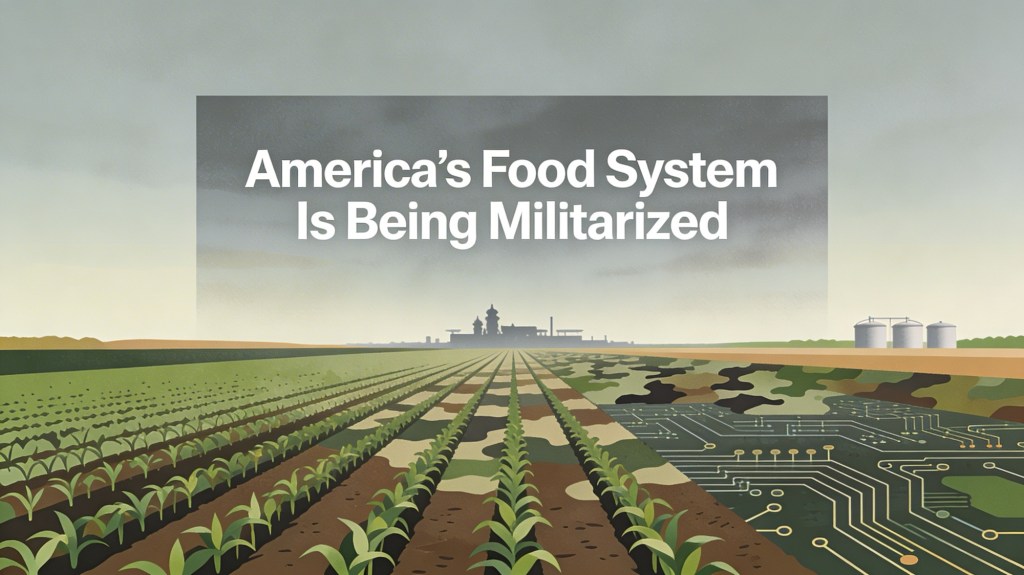
Two recent moves from Washington quietly locked U.S. agriculture tighter into the national‑security state: an executive order putting glyphosate and elemental phosphorus under the Defense Production Act, and a USDA–War Department pact to treat farms as critical security infrastructure. Together, they don’t just “protect farmers.” They hard‑wire the current pesticide‑heavy model of agriculture into U.S. defense policy.
⸻
Glyphosate as National Defense
President Donald Trump’s new executive order declares that elemental phosphorus and glyphosate‑based herbicides are crucial to national security, tying them directly to food‑supply stability, military readiness, and industrial production. The order invokes defense‑production powers to prioritize contracts, allocate industrial capacity, and guarantee a continued, “adequate” domestic supply of these inputs. In effect, glyphosate is being treated like jet fuel or missile components: a strategic material the state will actively protect, subsidize, and prioritize.
⸻
How “Immunity” Turns a Toxic Input into a Protected Asset
Trump’s executive order doesn’t just elevate glyphosate to the status of a defense asset; it wraps its producers in a legal force field. By invoking the Defense Production Act (DPA), the order triggers section 707, a provision that grants “all immunity” to companies that comply with federal production directives for elemental phosphorus and glyphosate‑based herbicides. In practice, that means when the government tells these firms to ramp up or redirect production in the name of “national defense,” they gain protection from a range of civil liabilities tied to those actions, including certain damages and antitrust claims.
This is especially alarming in the context of glyphosate’s legal and scientific baggage. The WHO’s cancer research arm has already classified glyphosate as “probably carcinogenic to humans,” and Bayer/Monsanto has spent years battling and settling lawsuits from people who say their cancers are linked to exposure. Now the same chemical is being formally branded “critical to national security,” while its makers are told, in effect, that if they follow the government’s orders, they’ll enjoy an extra layer of legal insulation. The order’s own language claims that “lack of access to glyphosate‑based herbicides would critically jeopardize agricultural productivity, adding pressure to the domestic food system,” positioning any constraint on glyphosate not as a public‑health precaution but as a security threat.
⸻
The USDA–War Department Farm Security Pact
Just days earlier, USDA leaders and the War Department signed an agreement to implement the National Farm Security Action Plan, formally bringing the defense apparatus into the governance of U.S. agriculture. This pact commits both agencies to share intelligence on “security vulnerabilities” in agriculture, coordinate on designating key fertilizer inputs as critical, align grant rules, and block funding or certifications for entities tied to designated foreign adversaries. It also launches a partnership between DARPA and USDA’s science office, with joint R&D and personnel exchanges aimed at “protecting” the agricultural supply chain from cyber, biosecurity, and foreign threats.
⸻
Why This Matters for Farmers and Public Health
It locks in chemical‑intensive agriculture
By elevating glyphosate‑based herbicides and elemental phosphorus as defense priorities, the administration is baking the existing chemical‑input model into national‑security doctrine instead of treating it as something we might need to transition away from. Agribusiness and input‑industry groups have already applauded the order as a guarantee that their core products will be shielded from disruption rather than regulated more aggressively. This direction also undercuts earlier health‑focused efforts that spotlighted glyphosate and other pesticides as emblematic of systemic regulatory failure.
It militarizes food policy
Framing farmland and fertilizer as “vital national‑security assets” pulls food policy into a world of classified briefings, restricted data, and security exceptions that can sideline local communities and public‑interest watchdogs. Once agriculture is wired into the defense bureaucracy, decisions about what gets sprayed, who owns land near bases, and which technologies are favored are more likely to be made in closed‑door security channels than in open democratic debate. The more these systems are securitized, the harder it becomes to challenge them without being painted as undermining “national defense.”
It sidelines deeper health and justice questions
Independent scientists, farmworker advocates, and environmental‑health campaigns have raised serious concerns about chronic exposure to glyphosate and other pesticides, especially for rural communities and children. Earlier policy discussions acknowledged that the current pesticide regime creates a “toxic soup” of exposures that fall heaviest on the least powerful. The new executive order and farm‑security framework, however, recast those same chemicals as assets to be defended, shifting attention away from whether they should be phased down or replaced and toward how to guarantee supply in perpetuity.
⸻
What This Means Going Forward
For conventional farmers, the immediate signal is that Washington will backstop the input‑heavy status quo: fertilizer and glyphosate supplies will be protected, foreign acquisition of land and plants will be scrutinized, and defense‑linked funding may increasingly flow toward “secure” ag infrastructure. For communities worried about pesticide exposure, soil degradation, climate vulnerability, and corporate consolidation, the signal is far more ominous. The systems they’ve been trying to reform are being wrapped in camouflage and rebranded as patriotic necessities.
A pesticide that independent scientists and courts are still fighting over is being locked into place by redefining it as infrastructure for war readiness and food “stability,” then shielding its producers when that choice harms people or ecosystems. The message is clear: in the emerging doctrine of “food as defense,” the rights of corporations to sell a controversial chemical are being fortified, while the rights of communities to challenge that chemical’s harms are quietly pushed to the perimeter.
If food and farming are treated as battlegrounds in a new era of great‑power rivalry, debates over pesticide restrictions, land consolidation, and food justice risk being reframed as security threats rather than legitimate democratic demands. The core question is no longer whether agriculture matters to national security (it does), but who gets to define “security,” and whether that definition protects people and ecosystems or the uninterrupted flow of herbicides and fertilizer.
⸻
Stay Curious
⸻
 A Curious Stack
Leave a comment