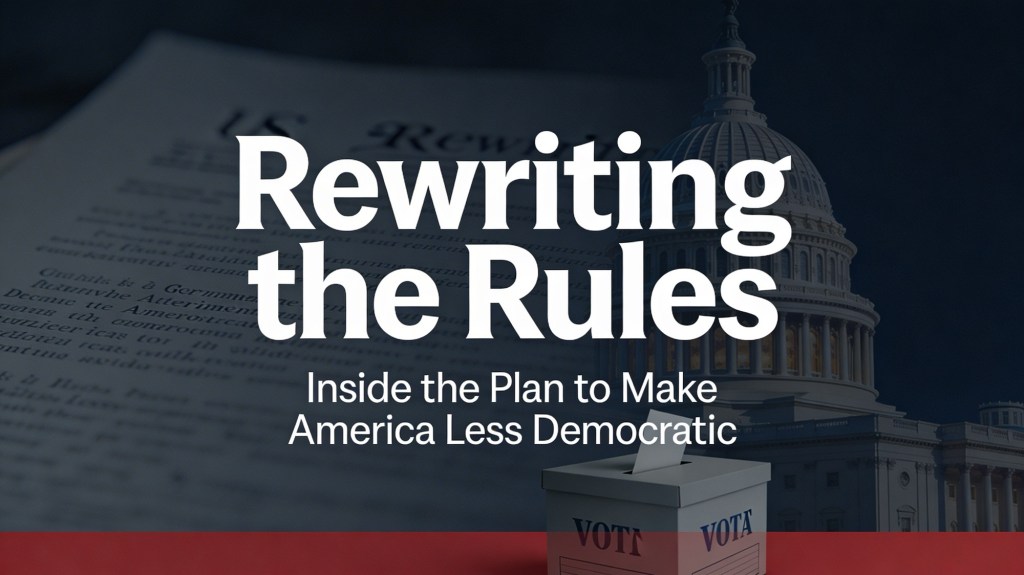
Over the last few years, a lot of complicated things have happened all at once: raids on election offices, fights over voter rolls, giant new detention budgets, and a 900‑page plan called “Project 2025.” It’s easy to see each piece as separate noise.
They’re not separate. They’re part of a long, organized effort to change how America is run.
This post walks through that effort in simple language, so you can see the whole picture, not just the headlines.
⸻
1. The Big Blueprint: Project 2025
A group led by the Heritage Foundation created a huge plan called Project 2025. It’s a manual for how a conservative president should reshape the government from the inside.
In plain terms, the plan aims to:
- Put more power in the president’s hands, and less in “independent” agencies and career civil servants.
- Fill government jobs with loyal political allies, not neutral professionals.
- Roll back protections for LGBTQ people, women, immigrants, and voters, using legal language and “religious freedom” arguments.
- Change how elections are run and enforced so it becomes easier for one faction to stay in power.
Think of it as a step‑by‑step guide to “institutionalizing Trumpism” so it keeps going even if Trump himself leaves office.
⸻
2. Elections: Making It Harder to Vote and Easier to Control the Outcome
2.1. Voter rolls and the DOJ
The current Justice Department is pushing states to hand over their full voter registration lists: names, addresses, driver’s license info, partial Social Security numbers.
Their stated plan:
- Combine those state lists with federal databases (immigration, Social Security, DHS).
- Flag “possible non‑citizens” or “duplicates.”
- Send purge lists back to the states with pressure to remove those voters quickly.
Sounds reasonable until you remember something crucial: these databases were never built to verify everyone’s voter status. They’re messy. They’re outdated. They mislabel people.
Who gets hit hardest?
- Naturalized citizens (records still say “non‑citizen”).
- People with common names.
- People who move a lot, marry, or change their names; often younger voters, renters, and voters of color.
When purges are fast and error‑prone, thousands of eligible voters can be wiped off the rolls without ever doing anything wrong.
2.2. The SAVE Act
The SAVE Act (Safeguard American Voter Eligibility Act) is a bill that makes this even worse.
In simple terms, it would:
- Require paper proof of citizenship (passport, birth certificate, naturalization papers) to register or update your registration for federal elections.
- Force states to constantly search for “non‑citizens” on the rolls and remove them.
- Create new crimes and lawsuits for election officials who register someone without the “right” paperwork, even if that person is a citizen.
Most citizens don’t have a passport or a handy copy of their birth certificate. Many can’t easily replace them. So the SAVE Act doesn’t just stop non‑citizens (who are already banned from voting). It blocks and scares off millions of citizens, especially poor and marginalized people.
When you combine:
- national‑level data matching,
- pressure to purge quickly, and
- harsh penalties for officials who are “too lenient,”
you get a system where it’s safer for bureaucrats to remove people than to keep them registered.
That’s how you tilt elections without touching a ballot box.
⸻
3. Weakening the Referees: FEC, DOJ, and the Courts
3.1. The FEC (campaign money referee)
Instead of making the Federal Election Commission stronger and more independent, Project 2025 wants to:
- Keep it weak and gridlocked, so big donors and campaigns can break the rules with little risk.
- Raise donation limits so wealthy people can pour more money directly into campaigns.
- Tell the Justice Department to back off prosecuting campaign‑finance crimes unless the FEC explicitly asks for it—which the FEC often refuses to do.
Translation: the people with the most money get fewer rules and fewer consequences.
3.2. DOJ as a political weapon
The Justice Department is supposed to protect voting rights and enforce the law fairly.
Under this agenda, its role shifts:
- Less focus on protecting voters from suppression.
- More focus on hunting for “voter fraud,” raiding election offices, and intimidating local officials.
- More power concentrated in politically loyal appointees at the top.
We’ve already seen an example: the FBI raid on Fulton County’s election hub in Georgia, justified using old, debunked fraud claims. The affidavit leaned on shaky activist reports and still managed to seize nearly all of Fulton’s 2020 ballots and records, which are now in federal hands.
That doesn’t prove a stolen election, but it shows how federal power can be used to cast doubt, seize control of evidence, and intimidate local election officials.
3.3. Courts and judges
Trump’s movement has already:
- Tilted the Supreme Court 6–3 conservative.
- Packed lower federal courts with ideologically aligned judges.
- Started firing or pushing out military leaders and replacing them with personal loyalists.
Courts still matter, but they’re slower, more conservative, and less willing to check the president than they were a decade ago. And even when courts rule against the White House, enforcement can be delayed or half‑hearted.
So “the courts will save us” is not a plan. At best, they’re a bumpy brake pedal, not a guaranteed stop.
⸻
4. Massive Detention Infrastructure: Who It’s For Now—and Who It Could Be For Later
Congress has approved huge budget increases for DHS and ICE, including:
- More detention centers and tent camps.
- More beds and guards.
- Looser rules around who can be detained and for how long.
Officially, this is for immigration enforcement and mass deportations.
In practice:
- LGBTQ asylum‑seekers and migrants are already at serious risk of abuse, denial of care, and deportation back to dangerous countries.
- Oversight is limited. Data tracking of trans detainees is incomplete or disappearing.
- Once the physical and legal infrastructure for mass detention exists, it’s very easy to relabel its targets from “illegal immigrants” to “rioters,” “extremists,” or “domestic threats.”
No one is openly announcing “camps for LGBTQ people” or political opponents. They don’t have to. They can use existing labels (immigration violations, public order, vague “terrorism”) to justify locking people up.
⸻
5. Culture and Family: Making Non‑Conforming People Second‑Class
Heritage’s 2026 reports on “Saving America by Saving the Family” tell us a lot about the social side of this project.
The vision:
- The “ideal” American family is a married, straight couple with children, one breadwinner, one stay‑at‑home parent.
- Policies (tax credits, benefits, welfare rules) should reward this model and quietly punish or discourage everything else: single parents, cohabiting couples, LGBTQ families, blended families.
Project 2025 and related plans also call for:
- Rolling back LGBTQ anti‑discrimination protections in employment, education, housing, and health care.
- Restricting or banning gender‑affirming care, even for adults.
- Pressuring schools to remove LGBTQ‑inclusive books and curriculum, and to ignore or erase trans students’ identities.
The likely end state isn’t just “we disagree with you.”
It’s LGBTQ people technically exist but are legally vulnerable, medically unsupported, and socially punished for being visible.
⸻
6. Emergency Powers: Insurrection Act + “Law and Order”
Layer on top of all this the Insurrection Act, an old law that lets the president deploy active‑duty troops inside the U.S. in certain situations.
Trump has already:
- Talked publicly about using it on protests.
- Replaced top generals and commanders with people seen as personally loyal.
Imagine a trigger moment:
- Huge protests over a pardon for someone like Ghislaine Maxwell.
- Unrest tied to the Epstein files and elite impunity.
- Election‑related clashes or police violence.
In that context, the White House could claim:
“There is an insurrection”
“Federal law can’t be enforced”
and invoke the Insurrection Act to send in troops.
Is that legal? Dubious.
Is it stoppable in the moment? Not easily.
Even then, it’s not a magic dictatorship button, Troops still have rules, and states, courts, and the public can resist. But it raises the stakes for protest and dissent in a system that already has more detention capacity, a weaponized DOJ, and weakened media and courts.
⸻
7. So Where Does That Leave Us?
Put all of this together and you get a clearer picture:
- Elections: narrower, more controlled electorate; more purges; more “fraud” show‑cases; more power to doubt and harass results they don’t like.
- Government: more loyalists, fewer independent referees, more power in the president’s hands.
- Vulnerable groups: especially LGBTQ people, immigrants, and dissenters, pushed toward second‑class status by law, policy, and fear.
- Force: larger, looser detention and policing powers, with emergency laws like the Insurrection Act ready as backup.
This is why it feels like so much is happening so fast: because it is. It’s not one law or one scandal. It’s a whole strategy.
⸻
8. What Ordinary People Can Still Do
None of this is a reason to give up. It’s a reason to get specific.
Here are some concrete types of action that still matter:
Local focus
- Know your state and local officials: governor, AG, county election board, sheriff, DA, school board.
- These are the people who decide: how purges are done, how protests are policed, whether to hand over data, whether to cooperate with abusive federal actions.
Information networks
- Build small, trusted circles, offline and online, where you share verified information, not just vibes.
- Save key documents and links; don’t rely on one platform’s algorithm to surface the truth.
Legal and mutual‑aid support
- Know which organizations in your area help with bail, legal defense, voter protection, and immigrant support.
- If you have skills (writing, design, tech, organizing), plug them in there.
Narrative work
- Explain this stuff in simple language to people who don’t live on political Twitter/Threads: family, coworkers, faith communities, neighbors.
- Use stories and concrete examples: “Here’s how this law could knock you or your neighbor off the voter rolls,” not just abstract warnings.
Sustainable engagement
- This is a marathon, not a 48‑hour crisis. Pick one or two lanes where you can show up consistently: local elections, court‑watching, protest support, education, or digital content.
⸻
The people driving this plan are smarter and more prepared than many give them credit for.
But they’re not gods. They’re running a long, risky play that depends on most people:
- not understanding the mechanics,
- not believing things can change, or
- burning out and checking out.
The more clearly we see the pattern, and the more we act in grounded, local, sustainable ways, the less room they have to quietly rewrite the system around us.
⸻
Stay Curious.
⸻
Sources
- H.R. 22 – SAVE Act bill text (Congress.gov)
 A Curious Stack
Leave a comment