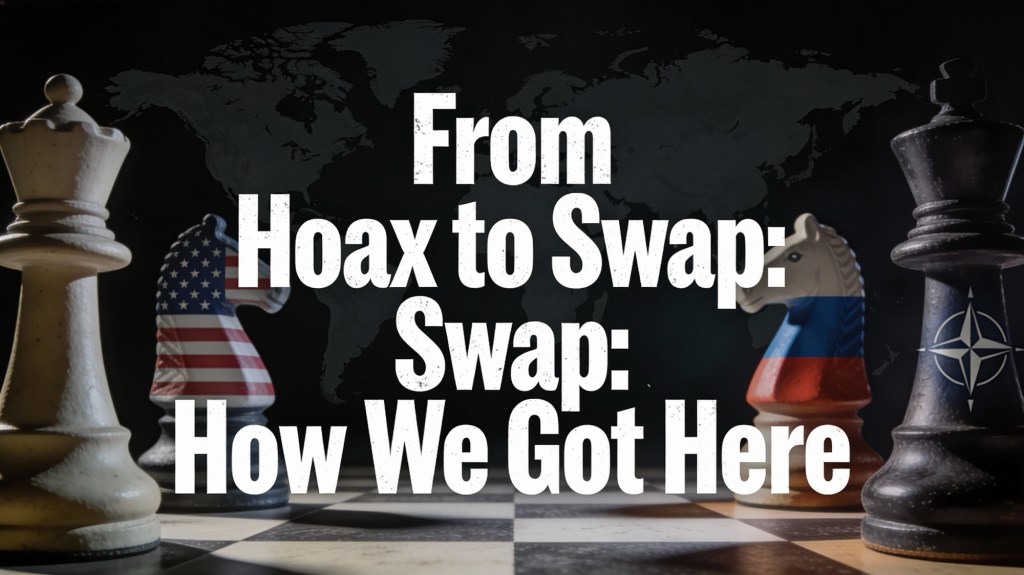
For years, Americans were told that concerns about Trump and Russia were overblown—just partisan hysteria or a “witch hunt.” Yet when you lay out the actual record, a different picture emerges: a political leader whose finances were buoyed by Russian‑linked money, whose campaign was flagged as a grave counterintelligence threat, and whose foreign policy keeps echoing the Kremlin’s own spheres‑of‑influence logic.
Now add Fiona Hill’s testimony about a proposed Venezuela–Ukraine “swap,” and Trump’s renewed threats to take Greenland even by force, and the pattern stops looking random.
⸻
The Money: How Russian Capital Helped Revive Trump
By the early 1990s, Trump was not a “great businessman.” He was drowning.
- Trump’s empire was billions in debt, multiple casinos and hotels had gone through bankruptcy, and mainstream U.S. banks largely walked away from him as a credit risk.
- In the late 1990s and 2000s, a wave of buyers from Russia and the former Soviet Union poured money into Trump properties. Investigations have documented that Russian and post‑Soviet buyers made up a significant share of high‑end condo purchases in Trump World Tower and Trump‑branded Florida projects, tens of millions of dollars in cash that helped keep the brand alive.
- Trump’s company partnered with Bayrock, a firm run by a former Soviet official and based in Trump Tower, and increasingly relied on Deutsche Bank, the same bank later caught laundering billions for Russian clients, including oligarchs, though a direct pass‑through from specific laundering cases to Trump has not been proven in court.
- One standout deal: Trump bought a Palm Beach mansion for about $41 million and sold it a few years later to Russian oligarch Dmitry Rybolovlev for $95 million, despite doing little to improve it; a windfall that raised eyebrows among corruption and money‑laundering experts.
None of this proves a signed contract that says “You work for the Kremlin now.” But it does establish that when U.S. financing dried up, Russian and post‑Soviet money became a crucial lifeline for Trump’s business.
⸻
The Counterintelligence Problem Washington Won’t Admit
When Trump entered politics, that history didn’t disappear. It became a national‑security question.
- The Mueller report concluded that the Russian government interfered in the 2016 election “in sweeping and systematic fashion,” and documented numerous links between Trump’s campaign and individuals tied to the Russian state.
- Investigators did not find enough admissible evidence to charge a formal criminal conspiracy. But they did document repeated lies and misleading statements from Trump associates about their Russian contacts, as well as extensive obstruction‑of‑justice issues.
- A subsequent bipartisan report from the Senate Intelligence Committee went further on the security risk, calling the Trump campaign’s relationship with Russia a “grave counterintelligence threat” and detailing, among other things, Paul Manafort’s sharing of internal polling data with a man assessed as a Russian intelligence operative.
For a normal federal employee, this pattern of murky foreign money, oligarch links, and repeated lies about contacts with a hostile power, would almost certainly mean loss of clearance, aggressive investigation, and likely prosecution. Instead, it became background noise for a sitting president and now, again, the occupant of the Oval Office.
⸻
The “Very Strange Swap”: Venezuela for Ukraine
Fiona Hill, Trump’s former Russia adviser and a career Russia expert, added another disturbing piece in testimony that has now resurfaced.
- Hill told Congress that in 2019, Russian officials repeatedly floated a “very strange swap arrangement between Venezuela and Ukraine”: Moscow would back off its support for Nicolás Maduro if Washington effectively granted Russia a freer hand in Ukraine.
- She was dispatched to Moscow to kill the idea and says she told Russian officials that “Ukraine and Venezuela are not related to each other” and such a trade was unacceptable.
On paper, that’s where it ended. But the mindset is the point: Russia was explicitly testing whether the United States would return to old‑style great‑power bargaining, where big states horse‑trade entire countries over the heads of their people.
Fast‑forward a few years and Trump launches a U.S. raid that captures Maduro, leans hard on the Monroe Doctrine, and now threatens to “take” Greenland, a Danish territory, with the White House pointedly refusing to rule out force. The echo of the earlier “swap” logic is hard to miss.
⸻
Greenland and the Slow‑Motion Collapse of NATO’s Taboo
Greenland is not a bizarre fixation. It is a stress test for whether anything of the post‑1945 order still constrains American power.
- Greenland is part of the Kingdom of Denmark and covered by NATO’s mutual‑defense guarantees and a U.S.–Danish defense pact that already gives the U.S. extensive military access.
- Trump’s renewed talk of “acquiring” Greenland, and aides refusing to take the military option off the table, has triggered open warnings from European leaders that any U.S. attack or forcible takeover would mean “the end of NATO.”
- Analysts at Chatham House and other institutions note that this would invert Article 5: instead of all for one, the dominant member would be attacking another ally, forcing Europe into an impossible choice between confronting Washington or accepting that the alliance’s core promise is dead.
In that light, Greenland shows whether the U.S. is shifting from “leader of an alliance of equals” to a 19th‑century empire that seizes what it wants, even from its own partners, and dares them to stop it.
⸻
Useful Asset vs. Formal Agent
Where does all this leave the “Russian asset” question?
- Public evidence does not prove that Trump is a formally recruited, task‑taking agent of Russian intelligence in the narrow legal sense. Investigations haven’t produced that smoking gun.
- But the combination of financial dependence on Russian‑linked money, a campaign labeled a grave counterintelligence threat, consistent praise of Putin, attacks on NATO and Ukraine assistance, openness to sphere‑of‑influence logic like the Venezuela–Ukraine “swap,” and now threats to shatter NATO over Greenland all move in one direction: Trump governing in ways that reliably advance Kremlin strategic interests.
Intelligence professionals have a term for this: an asset of opportunity. Someone whose ego, vulnerabilities, and incentives line up so neatly with your goals that you can exploit them without ever needing them to sign on the dotted line.
⸻
What This Says About Us
If an average American had this record, they would likely be under indictment or at least permanently locked out of sensitive positions. Instead, that person is running U.S. foreign policy, dangling NATO’s survival, Ukraine’s future, Venezuela’s sovereignty, and Greenland’s status over the edge for ratings and leverage.
That gap, that refusal to apply basic counterintelligence standards to the most powerful office in the system, highlights a political and media ecosystem that has decided a certain level of captured, oligarch‑friendly, chaos‑driven leadership is acceptable, as long as it keeps the show going.
The question is no longer whether Trump is “really” a Russian asset in some narrow legal sense.
The question is how long we are willing to live in a world where the people making life‑and‑death decisions for Ukrainians, Venezuelans, Palestinians, Greenlanders, and for us, are treated as untouchable even when their behavior would be a giant red flag for anyone else.
⸻
Stay Curious.
⸻
Sources
- Foreign Policy – “How Russian Money Helped Save Trump’s Business” – link
- The Moscow Project – “Bailed Out by Russia” – link
- Center for American Progress – “Following the Money: Trump and Russia‑Linked Transactions” – link
- ProPublica – “Why Did Deutsche Bank Keep Lending to Donald Trump?” – link
- The Moscow Project – “Trump, Russia, and Deutsche Bank: What We Know So Far” – link
- NPR – “Dark Towers Goes Inside Deutsche Bank” – link
- New York Times – “For Trump, Three Decades of Chasing Deals in Russia” – link
- U.S. Department of Justice – Mueller Report, Vol. I (PDF) – link
- Mueller Report (reprocessed PDF) – link
- American Constitution Society – “Key Findings of the Mueller Report” – link<
 A Curious Stack
Leave a comment