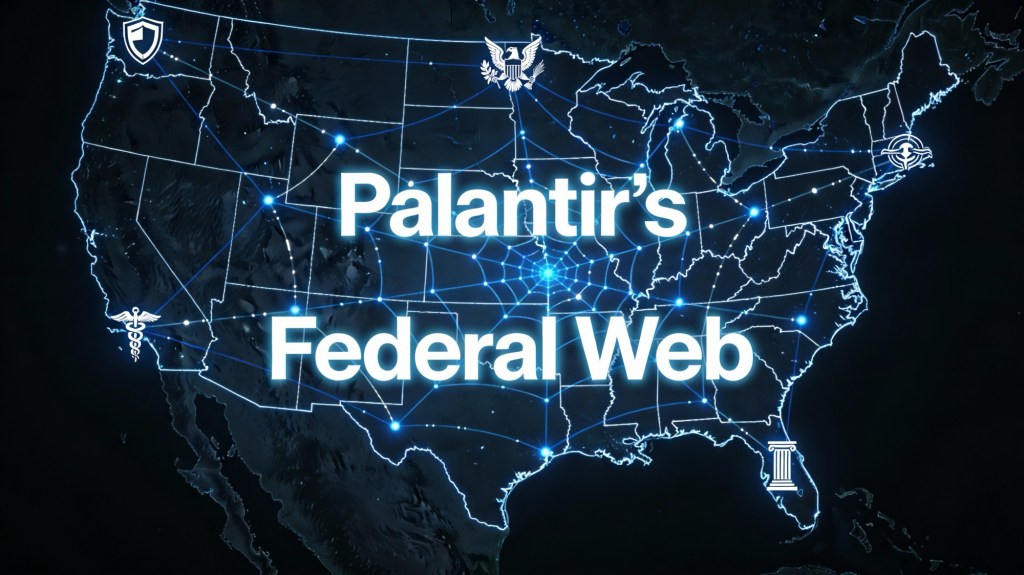
Palantir today is woven into the nervous system of the US state: the Pentagon’s AI stack, ICE’s deportation machine, veterans’ data, IRS analytics, FDA drug review, food supply chains, and more all sit on its platforms or their close cousins.
That concentration of data and decision‑support power raises an uncomfortable question: how hard would it be to weaponize this footprint to advance Peter Thiel’s deeply skeptical view of democracy and push the system toward more centralized, illiberal control?
This post explores the structural risks. It is not a claim that Palantir is currently executing a coup, but a look at how its existing contracts and Thiel’s own ideas could line up if the wrong political winds blow.
⸻
Thiel’s worldview: democracy as a “bug,” not a feature
In his 2009 essay “The Education of a Libertarian” at Cato Unbound, Thiel wrote: “I no longer believe that freedom and democracy are compatible,” arguing that mass suffrage and egalitarian politics had made genuine liberty impossible in modern societies.
Biographers and analysts have since described his politics as openly anti‑democratic and structurally authoritarian: he prefers strong, elite‑run structures (corporate governance, tech monopolies, illiberal regimes) to messy, participatory democracy.
In recent years he has doubled down on a geopolitical framing:
- He warns that the US is in a systems‑level contest with China and “one‑world government” technocracy.
- He argues that control over AI, energy, and data infrastructures will decide who wins that contest.
Seen through that lens, Palantir and General Matter look less like random bets and more like a targeted portfolio: own the core data platforms of the state (Palantir), and own the critical fuel that keeps AI and infrastructure online in crisis (General Matter).
⸻
Palantir’s government footprint: the emerging “OS” of the security state
Public data shows Palantir has become one of Washington’s favorite contractors for high‑stakes data problems, with more than 1.9 billion dollars in US federal obligations since 2008 and a sharp ramp‑up in 2024–2025. The picture by agency is striking.
Defense and intelligence
- Department of Defense overall – About 1.99 billion dollars in total obligations, making DoD Palantir’s largest federal customer.
- U.S. Army – Roughly 730.3 million dollars historically, plus a new 10‑year enterprise software and data agreement with a ceiling of up to 10 billion dollars to standardize analytics and AI across the Army.
- U.S. Air Force – About 486.2 million dollars.
- U.S. Special Operations Command – About 303.7 million dollars, including a single contract with potential value around 277.5 million.
- U.S. Space Force / Space Command – A 217.8 million dollar Space C2 Data Platform delivery order for space‑domain awareness and command‑and‑control.
DoD has also expanded AI‑heavy deals like Project Maven, adding hundreds of millions of dollars in 2025 to integrate Palantir’s tools for targeting and data fusion across combatant commands.
In plain language: Palantir’s software is increasingly where the US plans, tracks, and fights.
Immigration and internal security
- ICE / DHS – At least 248.3 million dollars to ICE alone for systems such as Investigative Case Management (Falcon) and the new “ImmigrationOS” surveillance and case‑management platform.
- A 30 million dollar prototype award and a 29.9 million dollar follow‑on task order give Palantir the job of building and expanding ICE’s core operating system, integrating biometrics, travel data, criminal records, and other feeds.
These tools already underpin large‑scale deportation and internal‑security operations, allowing agents to stitch together dozens of datasets into a single picture of a person’s life.
Health, veterans, and civilian data
- Department of Veterans Affairs – A 385.4 million dollar, 5‑year contract for the National Center for Veterans Analysis and Statistics (NCVAS) data platform, ingesting health, benefits, and demographic data from VA, DoD, HHS, SSA, and IRS.
- HHS / CDC / NIH – A 90 million dollar, 5‑year blanket purchase agreement making Palantir Foundry an approved analytics and data‑integration platform across HHS, on top of specific CDC and NIH awards such as the N3C COVID data environment.
- FDA drug review – A three‑year, roughly 44.4 million dollar contract to support CDER and the Oncology Center of Excellence with a Palantir‑based data platform for drug approvals and safety monitoring, including COVID‑19 treatments.
- FDA food‑supply chain – An approximately 22 million dollar expansion to run FDA’s 21 FORWARD initiative, which uses Palantir to track and analyze US food supply chains and respond to disruptions like the infant‑formula crisis.
Treasury and the IRS
- Department of the Treasury / IRS – Treasury’s 2025 IT modernization announcements describe Palantir as a core vendor for a unified data layer, APIs, and analytics across IRS systems, with multiple multi‑million‑dollar awards supporting fraud detection and case analytics.
Across these domains, Palantir markets itself as providing “data protection and governance” that preserves government “digital sovereignty,” claiming agencies keep full custody and control over their data while using Palantir’s tools to analyze and share it.
Critics argue that in practice this creates a powerful, opaque decision infrastructure that shifts real power toward security agencies and their software vendor.
⸻
From contractor to kingmaker: how this could be weaponized
Given that footprint, how could Palantir be weaponized in a direction that matches Thiel’s illiberal instincts?
1. Turning “decision support” into de facto rule
When the Army signs an enterprise deal with a 10 billion dollar ceiling to standardize on Palantir, day‑to‑day decisions increasingly route through Palantir dashboards and workflows: which units get parts, which missions get priority, how readiness is scored.
The same logic applies elsewhere: ImmigrationOS becomes how ICE “sees” migrants; NCVAS becomes how VA “sees” veterans; Foundry instances become how FDA “sees” drug safety and how Treasury “sees” taxpayers.
Formally, humans remain in the loop. Substantively, whoever designs:
- the data models,
- the risk scores,
- the default dashboards, and
- the integration rules
has agenda‑setting power across multiple agencies. Slight changes in what counts as “anomalous,” how risk tiers are calibrated, or which patterns are surfaced can systematically tilt outcomes toward more aggressive surveillance and enforcement—or toward leniency for certain actors—without a single statute being rewritten.
For a worldview that sees democracy as weak and “decisive” technocratic control as necessary, this is ideal: power shifts into code and configuration rather than public law.
2. Quietly building a social‑credit‑style infrastructure
Right now, Palantir’s deployments are nominally siloed by mission: defense, immigration, tax, health, veterans. But the technical and political incentives to cross‑link are obvious, and some integration already exists (for example, NCVAS pulling data from IRS and SSA, or 21 FORWARD combining FDA, USDA, and CDC data).
In a crisis or under a more authoritarian administration, it would be easy to justify:
- connecting IRS analytics with DHS watchlists “to combat terror finance,”
- merging public‑health and law‑enforcement data “for biosecurity and pandemic control,” or
- fusing DoD, DHS, and domestic intelligence streams “to counter hybrid warfare.”
Because Palantir is already a common technical denominator, building an informal social‑credit‑like layer—where tax behavior, travel history, health data, protest attendance, and social networks all affect how multiple agencies treat you—becomes much easier, even if no government ever announces a single, official score.
That kind of opaque, data‑driven stratification fits neatly with a politics that distrusts mass democracy and prefers rule by a security‑minded elite.
3. Hardening power under emergency conditions
Thiel has repeatedly suggested that crises reveal who truly holds power, whether the crisis is geopolitical, technological, or financial. In a scenario of grid strain, cyberattacks, or domestic unrest, Palantir’s dual role in defense and internal security becomes crucial:
- DoD would lean heavily on Palantir for targeting, logistics, and multi‑domain command‑and‑control.
- ICE and DHS would rely on ImmigrationOS and other Palantir systems for tracking, detention, and removal operations.
- Treasury and IRS could intensify financial surveillance and selective enforcement, using Palantir analytics to pressure dissident groups or regions.
- FDA, HHS, and VA platforms could be repurposed to manage “biosecurity risks” and allocate scarce care or supplies, potentially privileging “essential” or loyal populations.
If a future administration chose to formalize a loyalty or “stability” index, Palantir’s networked presence would provide a ready substrate—similar to how China’s social‑credit pilots ride on top of existing local scoring and data systems rather than a single monolith.
4. Lock‑in and inherited authoritarian potential
Even without malign intent, the complexity and cost of these systems create vendor lock‑in: once an agency has reorganized around Palantir workflows, re‑platforming is difficult and risky. That means:
- Oversight bodies find it hard to see or understand how decisions are really being made inside opaque, proprietary models.
- Future, more authoritarian leaders inherit a powerful, integrated machinery ready to be repurposed with relatively modest legal or policy changes.
The danger is structural: Palantir is building exactly the kind of highly centralized, security‑centric data infrastructure that an illiberal regime could exploit to turn Thiel’s post‑democratic thought experiments into practice.
⸻
Where General Matter’s fuel fits into the picture
Thiel’s bet on General Matter—the privately backed uranium enrichment startup—adds an energy‑security layer to this architecture.
- General Matter has DOE contracts under both the HALEU and LEU enrichment programs, slices of multi‑billion‑dollar efforts to build domestic uranium fuel capacity.
- It has a DOE lease for roughly 100 acres at the former Paducah Gaseous Diffusion Plant, plus rights to re‑enrich at least 7,600 cylinders of DOE‑owned uranium hexafluoride.
- Its stated mission is to provide “sovereign” nuclear fuel for AI data centers, defense installations, and allied grids in an era when AI loads could overwhelm existing electricity systems.
If Palantir is vying to be the software nervous system of the American security‑administrative state, General Matter positions itself as a future choke point in its energy metabolism.
In a serious crisis—large‑scale blackouts, cyberwar, or climate‑driven grid failures—entities that control both critical data platforms and strategic fuel supplies would wield disproportionate leverage over what stays online and who gets prioritized.
⸻
What this doesn’t prove—and what to watch
None of this proves that Palantir or Thiel are currently running a shadow government or executing a plan to seize formal power. The public record shows:
- A contractor aggressively building a central position in government data and decision‑support.
- A founder with a long paper trail of anti‑democratic, crisis‑focused thinking and admiration for strong, illiberal structures.
- A parallel bet on nuclear fuel enrichment explicitly framed as strategic leverage for AI, defense, and national power.
The risk is that the architecture being built—centralized, opaque, tightly coupled to security agencies, and now linked to sovereign energy—makes it far easier for a future illiberal coalition to harden a soft authoritarian order without dramatic constitutional ruptures.
For citizens, watchdogs, and policymakers, the most productive responses are structural rather than conspiratorial:
- Demand transparency and oversight over Palantir deployments, models, and cross‑agency data flows.
- Impose hard legal limits on how security, tax, health, and immigration data can be fused and scored.
- Invest in alternatives—public, open, or at least diversified platforms—so no single vendor becomes the de facto operating system of the state.
The story is not that Palantir has already seized power.
It’s that, if Thiel’s dystopian fascinations and Washington’s appetite for frictionless control continue to align, the stack being built today could make seizing or subverting democratic power tomorrow much easier than most people realize.
⸻
Stay Curious.
⸻
 A Curious Stack
Leave a comment