In 2025, the United States faces a dramatic realignment—a powerful coalition of Christian nationalists, far-right technocrats, and Silicon Valley elites is reshaping governance, public policy, and the fabric of democracy. This movement is driven by the conviction that the government should reflect strict, often patriarchal, biblical principles, and that technology should serve as an instrument of centralized executive power and social control.
The most visible blueprint for this agenda is Project 2025, authored by the Heritage Foundation and others. It calls for sweeping changes: the imposition of biblical law over public institutions, the removal of civil rights protections and progressive language, and the recruitment of staff vetted for loyalty to Christian nationalist ideals. Civil society, minority rights, and democratic checks and balances are increasingly under threat.
⸻
ideological foundations and methods
Christian nationalism in the US today is more than just a religious movement; it is a political ideology seeking to fuse a particular form of Christianity with American civic life, government, and identity.
Project 2025’s nearly 1,000-page playbook outlines proposals to abolish or defund federal agencies, roll back LGBTQ+ rights and abortion access, limit diversity and equity programs, privatize public education, and redefine human rights through a biblical lens.
Central priorities include:
- Erasing terms like “sexual orientation,” “gender identity,” “diversity,” “equity,” and “abortion” from all federal rules, contracts, and legislation.
- Dismantling agencies that oversee civil rights and minority protections.
- Replacing public education curricula with Christian nationalist “American exceptionalism.”
- Concentrating executive power and marginalizing the legislative and judicial branches.
This movement envisions not just a Christian nation, but a post-democratic order reminiscent of medieval Christendom, run by a “CEO-president” with sweeping authority—rejecting pluralism and institutional balance.
⸻
power brokers: Ideologues and strategists
Peter Thiel
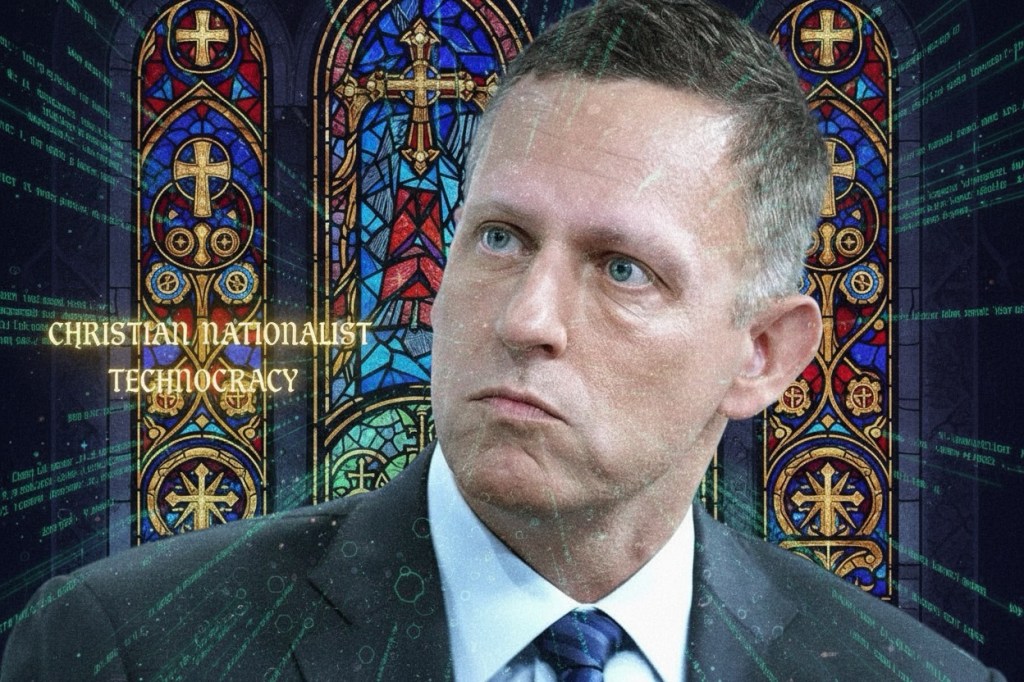
Peter Thiel, Silicon Valley billionaire and Christian nationalist, is an intellectual and financial architect of this movement. He merges libertarian tech futurism with apocalyptic religious narrative, believing that technology—especially mass surveillance—should be weaponized to defend Christian civilization against its critics. Thiel’s investments in key surveillance firms (notably Palantir) provide the tools for government and private actors to monitor and control dissent. His proteges, including JD Vance, have deepened the bridge between high-tech executive power and ideological governance.
⸻
Curtis Yarvin

Curtis Yarvin (aka Mencius Moldbug), once a fringe political theorist, has risen to prominence as the leading advocate of “Neo-Reactionary” or “Dark Enlightenment” ideology. Yarvin rejects the legitimacy of democracy, proposing instead that government should operate like a corporation, with a single technocratic “CEO” at the helm. His ideas have found traction among tech investors, conservative strategists, and figures like Thiel and Vance, catalyzing efforts to streamline federal power and purge progressive institutions.
⸻
Elon Musk
Elon Musk, formerly apolitical, now leads the Department of Government Efficiency (DOGE), where he applies Silicon Valley “disruption” logic to bureaucracy and public services. Musk’s reforms have transformed government operations, often bypassing oversight and transparency. His vast social media influence amplifies technocratic, anti-democratic, and Christian nationalist narratives.
⸻
JD Vance

JD Vance, the Vice President, exemplifies the synthesis of venture capital, Christian populism, and technocratic governance. Vance is tasked with enforcing Project 2025, purging staff not ideologically aligned, and ensuring the administration’s anti-LGBTQ+ and anti-abortion directives are carried out. Vance’s roots in Silicon Valley and close connections to Thiel and Yarvin position him as the pragmatic executor of the regime’s vision.
⸻
Heritage Foundation
The Heritage Foundation has evolved from a conventional conservative think tank into the command center of Christian nationalist technocracy. Its blueprints, legislative drafts, and personnel lists orchestrate executive orders and agency purges nationwide. The Foundation’s president, Kevin Roberts, has openly spoken of a “second American Revolution,” underscoring the movement’s ambition to remake government and society on biblical lines.
⸻
Steve Bannon

Steve Bannon, former White House strategist and media mogul, has played a critical role mobilizing public support and translating technocratic doctrines into a populist mass movement. His platforms, such as War Room, channel the voices and tactics of Thiel, Yarvin, Musk, and Vance, helping to mainstream loyalty pledges, purges, and sweeping legislative proposals.
⸻
Other influential actors include Russell Vought (Center for Renewing America), Kevin Roberts (Heritage Foundation), and Douglas Wilson, a vocal Christian nationalist pastor linked to Defense Secretary Pete Hegseth.
The “Shadow Network” of Christian right organizations, backed by billionaire donors, shapes everything from state legislative agendas to federal personnel databases.
⸻
technocracy in practice
The alliance of Christian nationalists and technocrats has produced significant, real-world changes in governance.
Across the federal landscape:
- Agencies are purged of secular, progressive, and minority staff.
- Civil rights programs are rolled back, targeting abortion, LGBTQ+ protections, and diversity initiatives.
- Surveillance tools are used in the name of combating “anti-Christian bias” or “woke subversion.”
- Education pivoted radically toward patriotism, biblical values, and censorship of materials seen as “dangerous” or “subversive.”
These measures are justified as restoring American greatness but amount to broad attacks on constitutional safeguards and pluralist democracy.
⸻
resistance and ongoing conflict
The rise of the fascist Christian nationalist technocracy has galvanized resistance from progressive Christians, secular organizations, minority groups, and democracy advocates. Many see the fusion of religious ideology, private capital, and surveillance power as an existential threat to pluralism, religious freedom, and democratic accountability. Legal challenges, protests, and investigations continue, targeting Project 2025 and its architects. Nevertheless, the integration of billionaire funding, private networks, and digital technologies has allowed the Christian nationalist technocracy to consolidate power at unprecedented speed.
⸻
conclusion
The United States in 2025 is witnessing an unprecedented consolidation of Christian nationalist and technocratic power. Led by billionaire visionaries, political strategists, radical theorists, and institutional blueprints, this movement has deployed surveillance, propaganda, and executive decrees to reengineer government and society.
The central players—Peter Thiel, Curtis Yarvin, Elon Musk, JD Vance, the Heritage Foundation, and Steve Bannon—hold outsized influence, driving an agenda that jeopardizes longstanding democratic norms, civil liberties, and religious pluralism. Their coalition stands as a stark challenge not just to specific policies, but to the structure and future of American democracy itself.
⸻
Stay curious.
⸻
 A Curious Stack
Leave a comment