⸻
Every once in a while, the universe reminds us how small we are — and how big the story really is. Most of what we see in the night sky stays neatly in its lane. But every so often, something drifts in from far beyond the reach of our Sun, an interstellar messenger that doesn’t belong here.
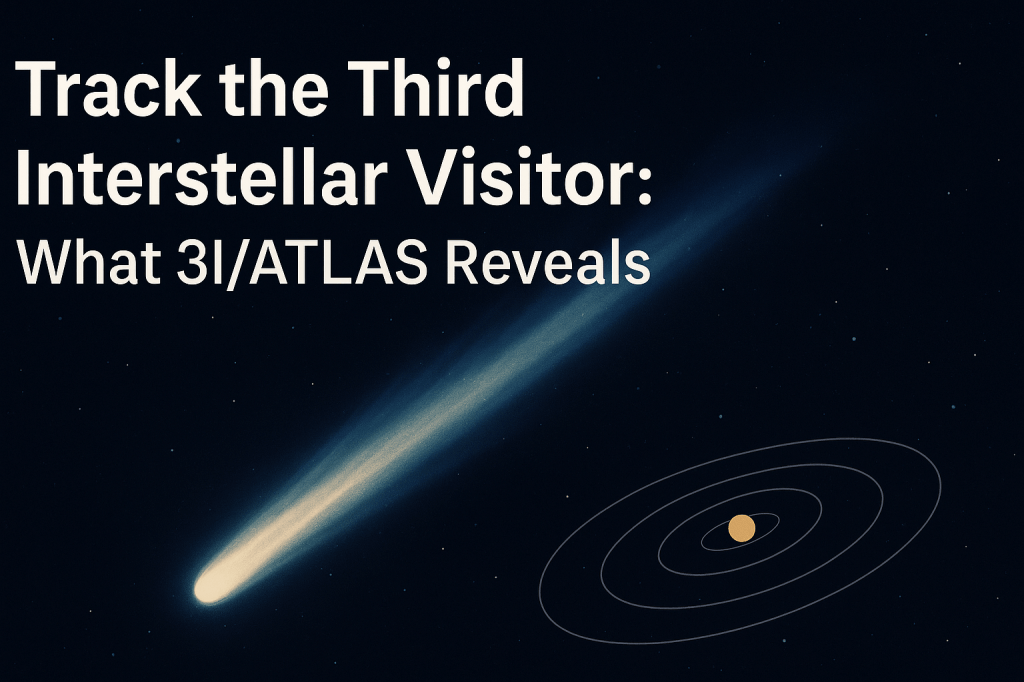
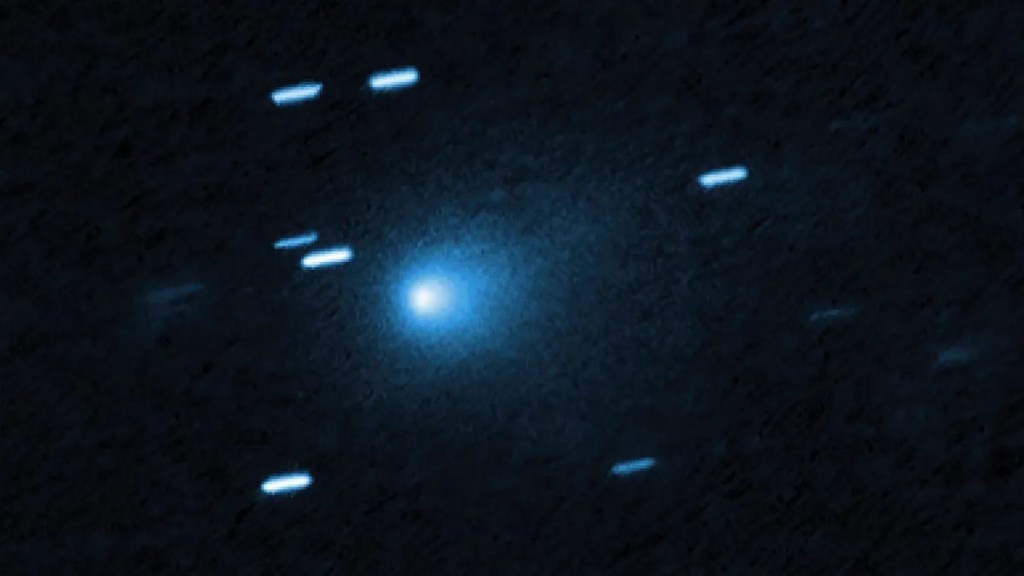
This time, it’s 3I/ATLAS, the third confirmed interstellar object ever discovered in our Solar System. It’s a traveler from another star system, crossing our cosmic neighborhood just long enough for us to take a look before it vanishes forever.
⸻
the discovery
Astronomers at the ATLAS Telescope in Chile first spotted 3I/ATLAS on July 1, 2025. At first, it looked like any other faint comet — until its orbit was plotted. The trajectory wasn’t an ellipse (like every planet and most comets) but a hyperbola, meaning it’s just passing through, never to return.
That realization immediately placed it in rare company. The first interstellar object, ʻOumuamua, arrived in 2017 and sparked global fascination with its strange shape and unexplainable acceleration. The second, Comet Borisov, appeared in 2019 and looked more like a classic comet, though one moving far faster than anything bound to our Sun.
Now, six years later, 3I/ATLAS joins the lineup — carrying with it clues about how other solar systems form and evolve.
⸻
the path through our solar system
After discovery, astronomers determined that 3I/ATLAS would reach its closest point to the Sun (perihelion) on October 30, 2025, about 1.4 astronomical units away — slightly inside Mars’s orbit.
Its closest approach to Earth will happen on December 19, 2025, at about 1.8 AU — roughly 269 million kilometers away. So, no, it’s not coming anywhere near us, but close enough for telescopes around the world to study it in detail.
Right now, 3I/ATLAS is gliding through the constellation Virgo. With a magnitude around 9.8, it’s far too faint for the naked eye, but dedicated amateur astronomers with a decent telescope can still spot it as a small, fuzzy glow moving slowly against the stars.
⸻
why 3I/ATLAS has scientists buzzing
What makes this object stand out isn’t just that it came from another star system — it’s how it behaves. Even while still far from the Sun, 3I/ATLAS began releasing gas and dust. That kind of early activity suggests it contains unusually volatile compounds like carbon monoxide (CO) and carbon dioxide (CO₂), which vaporize at colder temperatures than water ice.
In other words, it’s built from colder, more distant material — likely formed in the outer regions of its original star system before being ejected into interstellar space.
The comet is also showing non-gravitational acceleration — a subtle push caused by gas jets acting like tiny thrusters. This same behavior caused a stir with ʻOumuamua years ago, leading to wild “alien spacecraft” theories. But in this case, the data points clearly to natural outgassing — just not the kind we’re used to seeing from local comets.
⸻
watching a wanderer
For a while, 3I/ATLAS disappeared behind the Sun, making it tough to track. Now that it’s emerging into clearer skies, observatories across the world — and even in space — are back on the case.
NASA, the European Space Agency, and the SETI Institute are coordinating a global observation campaign. The Mars Express and ExoMars Trace Gas Orbiter spacecraft are even joining in, using their instruments from Mars orbit to collect data on its gas emissions.

Citizen scientists and astrophotographers are contributing too, feeding brightness and photometric data into shared databases that professionals use to refine models. For an object that won’t return, every minute of observation counts.
⸻
what it reveals about our place in the galaxy
Objects like 3I/ATLAS are time capsules — chunks of rock and ice that formed around another star, perhaps billions of years ago, and have been wandering through interstellar space ever since.
By studying them, astronomers can compare their composition and structure to comets in our own Solar System. If they’re made of similar materials, it suggests the processes that shaped our planetary system are common throughout the galaxy. If they’re different, it could hint at how varied other solar systems really are.
Either way, every interstellar visitor gives us a chance to understand where we came from — not just as a planet, but as a species living in a cosmic ecosystem.
⸻
a moment of perspective
There’s something profoundly humbling about this discovery. 3I/ATLAS has likely been traveling through the void for millions, maybe billions, of years. It’s crossed unimaginable distances, moving silently between stars, before brushing past ours — just for a few months of human observation — and then continuing on into the dark.
It’s easy to get caught up in daily noise: the endless scroll of news, notifications, and deadlines. But every so often, something like 3I/ATLAS drifts through to remind us that there’s a much bigger stage out there, and we’re lucky enough to be in the audience.
The fact that we can even detect such a small, faint object from another solar system says a lot about how far we’ve come — and how much we still have left to discover.
So the next time you look up at the night sky, remember this: somewhere out there, a traveler from another star is passing by, quietly leaving us with a story written in light.
⸻
how to follow its journey
- Track its position: TheSkyLive.com – 3I/ATLAS
- Official updates: NASA’s 3I/ATLAS page
- Science insights: SETI Institute – 3I/ATLAS Coverage
⸻
Stay curious.
⸻
 A Curious Stack
Leave a comment