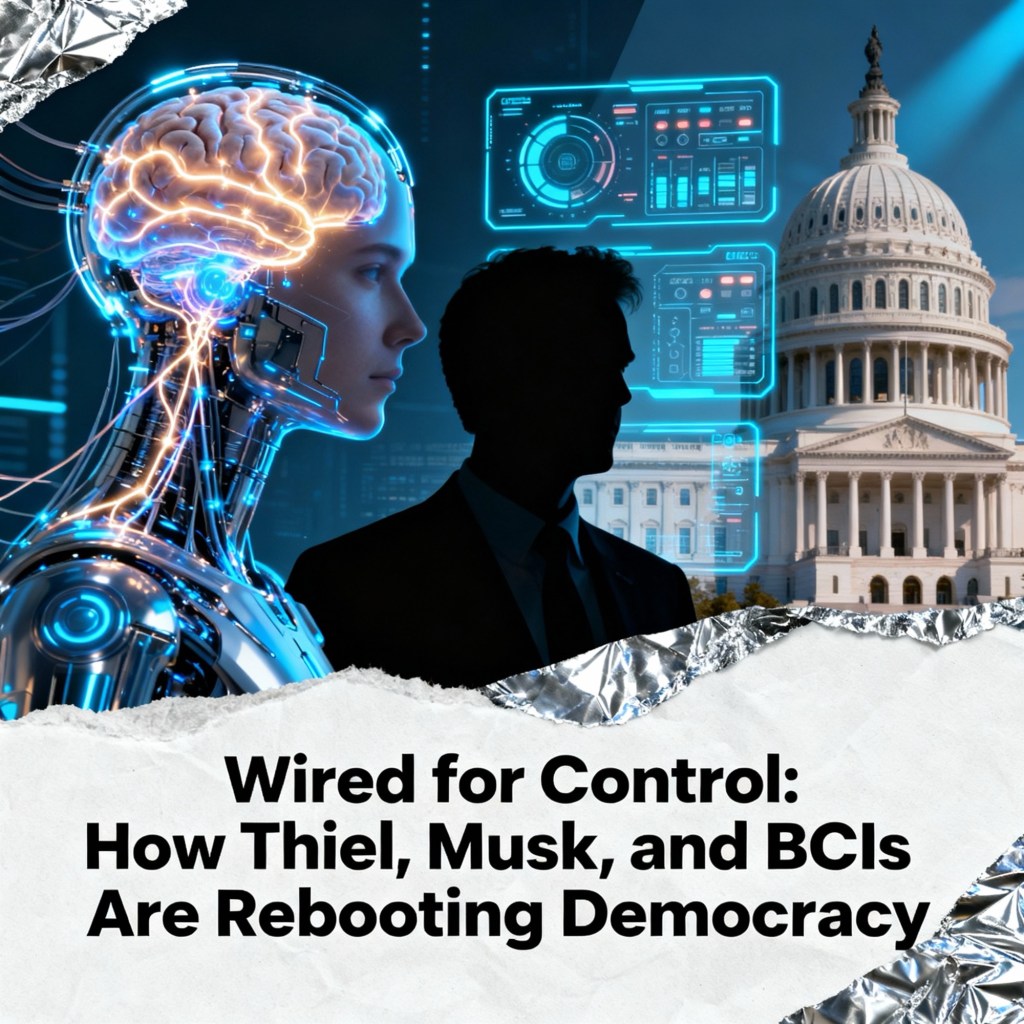

After the first collapse, the streets were empty, the ration lines shorter—only because the weakest and most vulnerable had already been culled. The survivors were those deemed “useful” for rebuilding: the strong, the adaptable, those with skills or genetic promise. For them, survival would require more than muscle or wit; it would demand integration into a new infrastructure. Every necessity—food, water, medicine, shelter—would be mediated not with cash or social ties, but with a mandatory brain implant.
To live, you had to be connected. The BCI (brain-computer interface) authenticated identity, tracked cognitive health, monitored productivity, and issued “resource credits.” Try to buy water without a stable neural profile? No sale. Need emergency care? Your implant’s digital signature must match the registry, firmware up-to-date, with no dissent flags. Want a job or a bed, or even to breathe through the city’s filtered dome? Approval was required.
In this world, the implant was no mere tool—it was the infrastructure of life. The system didn’t need soldiers so much as it needed systems of control, and technocratic power rested with those who owned the wires flickering with the data inside your skull.
⸻
The Quiet Cull: Depopulation as Policy
This isn’t dystopian fantasy. Current events reveal the emergence of what some call “the quiet cull”—a policy-driven, bureaucratically managed process of population reduction. Gutting of health agencies, slashed vaccine budgets, Medicaid unwinding, and rural hospital closures have already removed millions from the public safety net. Disease, poverty, and exclusion are leveraged as invisible filters, winnowing those unable to afford care or clear digital hurdles.
Scarcity, it turns out, is a ladder. As public services starve, elites buy up farmland, water rights, and distressed housing. Insurance is stripped from risky areas, leaving vulnerable communities to collapse. Every disaster, every crisis turns into an opportunity to consolidate control over essentials. The outcome is a smaller, weaker, digitally managed population—less able to resist, easier to surveil, and dependent on those who hold the keys.
⸻
Technocracy and the Architecture of Control
This shift is no accident; it’s the outcome of a rising technocracy. In this system, unelected “experts”—often drawn from corporate and technology sectors—deploy algorithms and data models to govern access to resources, rights, and even movement. The ideal of “efficient, objective rule” has become the reality of oligarchic management, with public debate replaced by code and metrics.
Foundational to this shift are sweeping legislative and executive actions:
- Digital Identification: Executive orders and federal investments now push universal digital identity—mobile IDs, biometric passports, digital benefits cards—that become gateways to work, healthcare, and basic civil participation.
- Cybersecurity & Predictive Policing: Cybersecurity mandates encourage the integration of real-time AI systems that vet risks, monitor threats, and even approve or deny access to social infrastructure. State-level biometric data regulations often lag behind the pace of adoption, creating a patchwork where private actors gain enormous power.
- Legal Gaps for Neurotech: Rapid advances in brain-computer interfaces outstrip federal protections. State-level efforts to regulate BCI data are easily bypassed or isolated. Opt-in schemes for neural authentication are spreading through pilot programs in healthcare and social services; inevitable function creep means these will become the new default IDs for access and participation.
⸻
Enslavement by Algorithm: The Rise of BCIs

As these systems solidify, the BCI—once sold as medicine or cognitive enhancement—becomes the ultimate tool for both inclusion and exclusion.
- Total Surveillance: BCIs offer real-time reading of mood, attention, and even prohibited or dissenting thoughts. Odd neural signatures may trigger digital quarantines, revoked access, or behavioral interventions.
- Conditional Existence: Every transaction can require neural approval. Algorithms decide—instantly and without appeal—who receives resources and who becomes stateless, jobless, or invisible.
- Cognitive Manipulation: Closed-loop “read-write” BCIs introduce the risk that thoughts can not only be observed, but altered. Propaganda, memory suppression, or behavior modification become new tools of compliance.
- Digital Eugenics: Admittance to society may rely on neural compliance, biometric rating, or firmware status, producing a dynamic, programmable caste system.
⸻
The Dark Enlightenment: Ideology for a Post-Democratic Regime
Underlying these developments is an ideological framework known as the Dark Enlightenment—popular among Silicon Valley technocrats and champions like Peter Thiel. This worldview explicitly rejects egalitarian democracy, advocating for rule by a wealthy, technologically advanced elite. Thiel, for instance, has invested in vast surveillance platforms (Palantir), militarized AI (Anduril), and biotech, openly advocating for post-democratic order.
The logic is explicit: public debate is slow and inefficient; algorithmic governance and elite control bring stability, profit, and “progress.” Rights, in this regime, exist by invitation—not by default.
⸻
Thiel’s Techno-States: Charter Cities and Private Sovereignty
This new order is no mere theory. Thiel and fellow venture capitalists are building techno-states: charter cities, “freedom cities,” and network states—autonomous or semi-sovereign city-states governed by corporate boards and funded by private capital. From the failed libertarian seasteading movement to successfully established corporate enclaves like Próspera (Honduras) and U.S. “freedom city” initiatives, these laboratory cities operate by alternative legal codes—their own.
Proposed bills would allocate public land to such projects, exempting them from most regulation and placing them under the rule of their investors. Within these spaces, BCI mandates, digital ID requirements, and algorithmic citizenship can be rapidly enacted, unchecked by traditional notions of civil liberty. This is governance as a contract, not a right; inclusion as a privilege, not a guarantee.
⸻
Laying the Legal and Infrastructural Groundwork
The foundation for this system is already in place:
- Universal Digital ID mandates: Executive orders plus bipartisan federal support are driving the country toward mandatory digital identification for nearly every aspect of public life—benefits, jobs, healthcare, and beyond.
- AI-based Security Directives: New rules encourage (and sometimes require) real-time AI vetting in access decisions for everything from welfare to public events.
- Fast-tracking Charter City Legislation: Political alliances are building to create legal enclaves for experiment in privatized, non-democratic governance and biometric control.
- Patchwork BCI regulation: A lack of strong federal rules means privacy, consent, and anti-discrimination protections are weak, letting rapid BCI adoption spiral into de facto requirement.

Together, these changes create the architecture for a society in which exclusion is seamless, algorithmic, and almost invisible. Never before has the machinery of democracy been so steadily repurposed for the management—and, where profitable, the disappearance—of the “surplus” population.
⸻
Conclusion: The Algorithmic Cull Is Now
The cull does not arrive with gunfire, but through paperwork, denial codes, firmware updates, and algorithmic flags. The future is already being written in the statute books, executive orders, neural terms of service, and charter contracts of today. In this emerging regime, technocratic and elite power is no longer a conjecture or a crisis—it is, quietly, the status quo.
⸻
Stay curious.
⸻
 A Curious Stack
Leave a comment