NOTE: Addendum at end of article
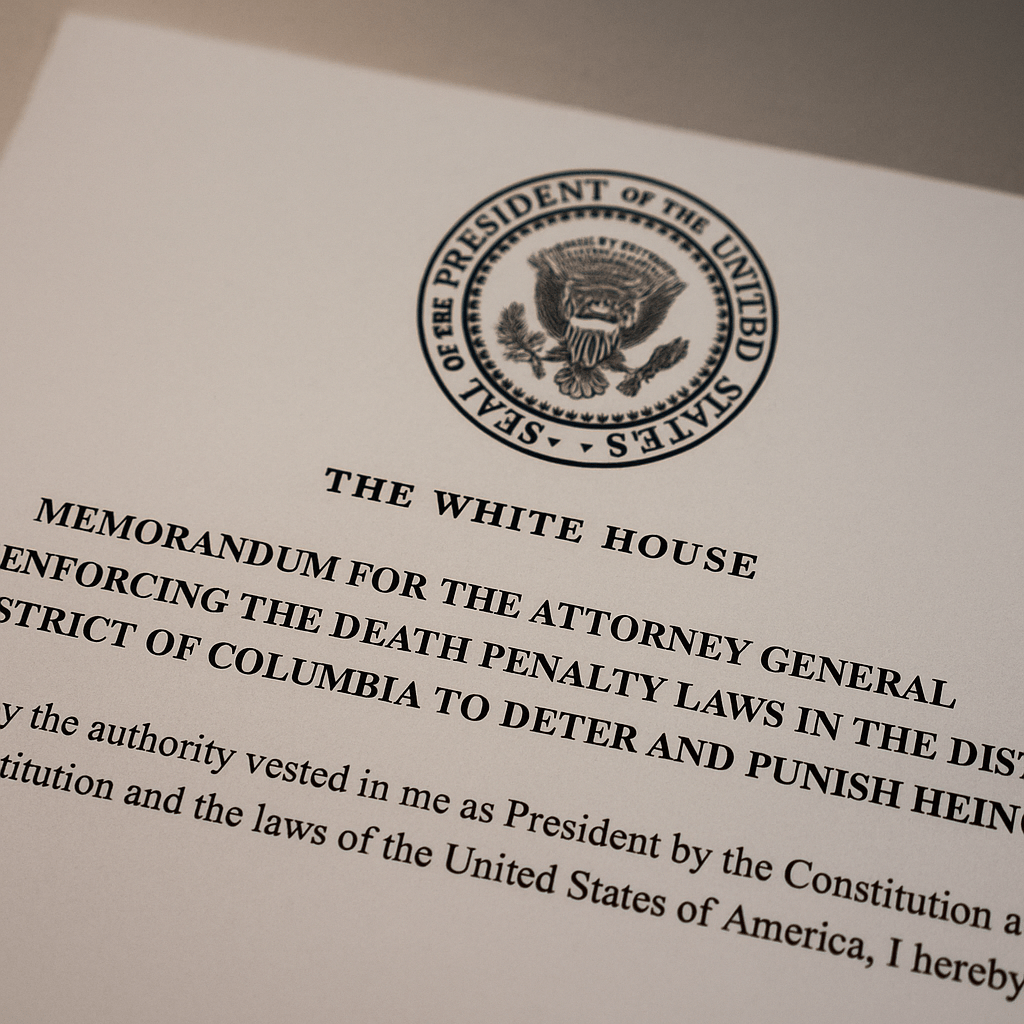
The memorandum appeared like a forgotten file uploaded to the federal archives—no press conference, no statement, just a new entry on the White House website. Its title, “Enforcing the Death Penalty Laws in the District of Columbia to Deter and Punish the Most Heinous Crimes,” looked bureaucratic enough to be ignored. Yet the document’s plain text carried an unmistakable shift: the federal government was quietly restoring the machinery of execution inside the nation’s capital.
Most Americans never saw it. The few who did probably didn’t give it a second thought.
The order directed the Attorney General and the U.S. Attorney for D.C. to pursue death in “all appropriate cases.” Because the District outlawed capital punishment in 1981, the instruction could only operate through federal authority, overriding local law. Within that federal framework sit a handful of crimes eligible for death: espionage, murder involving kidnapping, large-scale drug trafficking, and treason.
Treason stands apart. It is both a legal category and a rhetorical weapon—elastic enough to absorb whatever the regime in power calls disloyal.
The timing matters. The memo arrived amid Trump’s renewed campaign to portray domestic dissent as “terrorism” and “subversion.” In that climate, the resurrection of the federal death penalty in D.C. reads less like crime policy and more like groundwork—a precedent waiting for its first political application.
⸻
Background
For decades, the death penalty in federal law was a relic, used rarely and contested often. Its re-emergence in 2025 followed a series of deliberate administrative steps:
- In 2019, the Justice Department resumed federal executions after a 17-year pause.
- In 2020 and 2021, the White House expanded the list of qualifying crimes.
- By 2025, control over which crimes could be charged as capital offenses had effectively centralized within the executive branch.
The D.C. memo is the culmination of that trajectory—technical on paper, transformative in consequence. It hands the presidency direct influence over who may face death inside the symbolic core of American democracy.
⸻
The Broader Context
On the same day the memo appeared, Trump signed National Security Presidential Memorandum 7, titled “Countering Domestic Terrorism and Organized Political Violence.”
It orders every major agency to deploy “all lawful tools” against domestic extremism—a phrase without fixed definition.
Within hours, the administration issued a companion directive declaring Antifa a domestic terror organization. That declaration has no legal basis; U.S. terrorism designations apply only to foreign groups. Still, it reframed dissent as threat and gave federal prosecutors rhetorical license to treat protest as insurgency.
The White House described these moves as protective. The pattern suggests consolidation:
- Expand the meaning of “terrorism.”
- Link it to treason and national security.
- Reintroduce the death penalty under federal control.
- Center all of it in the District, where the federal government holds full jurisdiction.
Each act appears administrative; together, they redraw the relationship between citizen and state.
⸻
Legal and Constitutional Implications
Constitutional Definition of Treason: The U.S. Constitution specifically defines treason in Article III, Section 3, stating it is the act of levying war against the U.S. or adhering to their enemies, giving them aid and comfort.
The Constitution still outlines guardrails: treason requires two witnesses or a public confession; civil courts must remain open to bar military tribunals; habeas corpus can be suspended only by Congress during rebellion or invasion. These are not abstractions—they are the structural brakes designed to prevent political prosecutions.
But laws hold only as firmly as the people enforcing them. When loyalty outweighs principle, interpretation becomes the new instrument of control. Courts can be filled, prosecutors replaced, and oversight bodies repurposed. No statute needs rewriting if its meaning can be reshaped from within. The death-penalty memo illustrates that strategy: maintain the appearance of legality while changing its use.
The larger question is not whether Trump plans to execute political opponents, but whether the infrastructure for doing so is quietly being normalized. History rarely announces these turns in advance. They begin as policy revisions, staff reassignments, budget shifts — the slow administrative march toward exception becoming rule.
⸻
The machinery of control
The modern state rarely declares authoritarian intent outright; it builds it through layers of routine paperwork. Each step appears legitimate until the sum of them forms something that no longer resembles democracy. The pattern visible around the D.C. memo follows that script:
- redefine activism as extremism;
- move prosecutions from local courts, where juries are drawn from the community, to federal venues under executive influence;
- frame dissent as a “security matter,” allowing evidence to be sealed;
- place loyalists in key judicial and prosecutorial positions;
- narrow appeal routes and restrict injunctions;
- hold the power to call the military under the Insurrection Act (suspend habeas corpus)
Each order, appointment, or budget adjustment seems minor in isolation. Together they amount to a new operating system for state power—one in which the president can decide which citizens fall inside the category of “lawful enemy.”
⸻
Congressional complicity
With both chambers controlled by the GOP, oversight has faded into ritual.
Hearings are held, witnesses are sworn, but the questions serve the script. Committees that once investigated executive excess now amplify it. Bills expanding surveillance and redefining protest as “organized political violence” pass under the slogan of safety. There is still process, but little friction.
The system functions, but its conscience does not.
The witness machine
Treason and capital charges require proof—two witnesses or a confession in open court.
The administration has solved that inconvenience by manufacturing its own credibility. “Experts” sympathetic to its politics appear before Congress; paid informants echo official narratives; law-and-order pundits validate them on air. Reality becomes a chorus of confirmation.
As Reuters reported, Antifa is not an organization but a label applied to decentralized acts of protest. Yet the government now treats it as a structured enemy. Once a movement is declared real by decree, evidence becomes unnecessary.
⸻
Why it matters
Power changes meaning when it no longer fears limits. The D.C. memo may never be used to execute a protester, but it normalizes the idea that such an act would be legally conceivable.
When the president speaks of “traitors” and “the enemy within,” the legal framework already exists to match the rhetoric. If the Insurrection Act is invoked, troops could be deployed into American cities without governors’ consent. Detentions could follow under “security exceptions.” The forms would all be signed, the seals affixed, the process documented. It would look orderly.
That is the danger.
⸻
What to watch
⸻
✅ = Already happened
🟡 = Currently in progress
⛔ = Not yet happening
⸻
✅ NSPM-7 (Domestic-terror directive) – Active since Sept 25 2025.
✅ D.C. Death-penalty memo – Active; directs prosecutors to seek death in all eligible cases.
✅ “Antifa = terrorism” narrative – Active in official statements and media allies.
✅ Restructuring of DOJ/FBI units – Occurred; Reuters, March 2025.
🟡 Expansion of domestic-terror legislation – In committee; draft DTPA bill under review.
🟡 Insurrection Act threats – Repeated publicly; no formal invocation yet.
⛔ Capital prosecutions for protest activity – None verified.
⛔ New statute making dissent a capital offense – No proposal introduced as of October 2025.
⸻
Sources
White House memo on enforcing the death penalty in D.C.
White House NSPM-7: Countering Domestic Terrorism and Organized Political Violence
White House designation of Antifa as a domestic terror organization
TIME Magazine analysis of NSPM-7
Reuters report on FBI domestic-terror staffing cuts
Reuters coverage of Trump’s Insurrection Act threats
⸻
Reflection
History rarely turns on spectacle; it turns on signatures. The D.C. memo was one of them. It appeared ordinary, written in the neutral tone of government language, but it quietly repositioned the state’s power over life and death.
Patterns like this are not predictions—they are directions of travel.
The danger is less in what the order claims to do than in what it makes thinkable.
Those who study patterns know that once an idea becomes administratively possible, it rarely stays theoretical for long.
⸻
Stay curious. And antifascist.
⸻
Addendum: the blueprint all along
When most Americans tuned out the noise in 2019, the Trump administration quietly restarted something that had been dormant for nearly two decades: federal executions. It was a calculated move — not just symbolic, but structural — the first real test of a system designed to normalize state killing at the federal level again.
After a 17-year pause, Attorney General William Barr, under Trump’s direction, announced that the Bureau of Prisons would resume executions and modernize the protocol. Courts briefly intervened, but by July 2020, the machinery was running again — lethal injections delivered under new chemical standards, carried out with bureaucratic precision.
Between July 2020 and January 2021, thirteen people were executed by the federal government — the most in any presidential term since the 1950s. The public, distracted by a pandemic and an election in chaos, barely noticed the scale. But the deeper story was what those executions signified: a return to an older, harsher form of governance that conflated punishment with control.
The Quiet Expansion of “Qualifying Crimes”
While Congress determines which offenses can carry the death penalty, the executive branch controls how and when that power is used. In late 2020, as Trump’s first term neared its end, his Justice Department quietly pushed through new regulations that broadened the scope and methods of federal executions.
Those rules, published in the Federal Register just weeks before the election, authorized executions “in any manner consistent with federal law,” opening the door to a wider range of methods — from lethal injection to firing squads — and allowing state facilities and personnel to be used in federal executions. It was a subtle but seismic shift in authority: a legal framework designed for flexibility, mobility, and speed.
By broadening execution methods and centralizing control under the Attorney General, Trump’s DOJ created a policy structure that could outlast the administration itself. The “list of qualifying crimes” didn’t need to be rewritten — it simply needed to be interpreted more aggressively. Internal DOJ guidance could instruct prosecutors to pursue death penalty charges in more cases, under the rhetoric of “restoring law and order.”
The move was procedural on paper, ideological in practice. It positioned capital punishment not as justice, but as a mechanism of federal dominance.
What Happened Next
When Merrick Garland took over as Attorney General in 2021, he imposed a moratorium on federal executions and ordered a review of Trump’s late-term regulatory changes. But the infrastructure remained intact.
Every rule that expanded execution authority, every memo that widened eligibility, still exists — suspended, not erased. It can all be reactivated with a single order.
Looking back, it’s clear this wasn’t an abrupt shift in 2025 policy. The groundwork was poured years earlier. The Trump administration didn’t just resume executions — it institutionalized the capacity for a future government to weaponize them. The blueprint was always there.
 A Curious Stack
Leave a comment