from leaflets to feeds
In Vietnam, psyops were loud and literal. Helicopters dumped pamphlets over jungle villages. Loudspeakers urged defections. Radio stations broadcast “news” tailored to weaken enemy morale. It was crude, but everyone knew it was propaganda.
The United States doesn’t run them that way anymore. In 2025, a psyop doesn’t arrive fluttering from the sky. It arrives in your feed, carried by accounts you think are your neighbors, wrapped in memes, hashtags, or TikTok videos. The goal isn’t to announce authority but to disappear inside the noise.
⸻
the modern toolkit
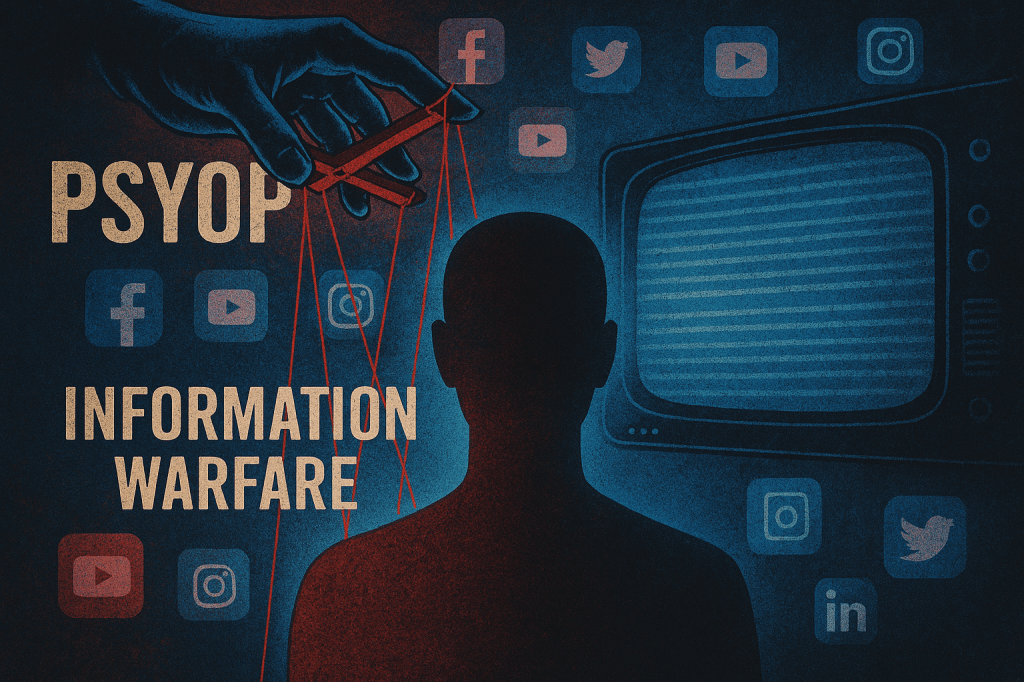
A modern U.S. psyop wouldn’t be a single broadcast. It would be a networked campaign across multiple platforms, designed to look organic.
- Sock puppet armies: fake accounts with stolen photos and mimicked slang, seeded across X, TikTok, Telegram. They interact with each other to create the illusion of grassroots chatter.
- Influencer laundering: instead of official press releases, talking points flow through “independent” creators — YouTubers, podcasters, TikTokers — who add credibility by claiming it as their own take.
- Information flooding: rather than censoring opposition, drown it. Thousands of posts bury competing stories in noise until truth is indistinguishable from rumor.
- AI-driven targeting: machine learning sorts audiences into microgroups and tailors the message to each one. Parents get fear content about kids; veterans get anger about betrayal; young people get rebellion memes.
- Memetic warfare: images and jokes carry ideology faster than speeches. The meme is the new pamphlet.
⸻
case studies: what it looks like in practice
philippines anti-vax operation
Reuters revealed in 2024 that the Pentagon secretly ran a campaign to undermine China’s Sinovac vaccine in the Philippines. Fake accounts posed as locals, spreading doubts about the vaccine’s safety. The aim wasn’t public health but geopolitics — to weaken China’s vaccine diplomacy. It was a live-fire test of fear-based persuasion. (Reuters , 2024)
⸻
centcom’s arabic sock puppets
In 2022, The Intercept and Al Jazeera reported that Twitter whitelisted accounts run by U.S. Central Command. They appeared to be local Arabic users but pushed pro-U.S. narratives, from justifying drone strikes to undermining adversaries. The whitelisting ensured the accounts spread further, faster, and with fewer checks. (Al Jazeera, 2022)
⸻
election manipulation at home
A 2024 study documented networks of accounts on X, Facebook, and Telegram pushing coordinated conspiracies and partisan outrage during the U.S. elections. Some activity was foreign, but some linked back to Western contractors. The same psyop tools used abroad are bleeding into domestic politics. (arXiv, 2024)
⸻
how to recognize one
Spotting a psyop means looking for the fingerprints that appear when you step back:
- Narrative synchronicity — dozens of accounts suddenly repeat the same phrase or frame.
- Origin mismatch — “local” accounts posting from the wrong time zones, with stock photos or awkward slang.
- Emotional spikes — the content hits fear or rage first, facts second.
- Memetic saturation — hashtags and memes appear faster than reporting, crowding out real journalism.
- Platform asymmetry — the same narrative shows up on multiple platforms at the same time.
- Official echo — planted narratives eventually get acknowledged by officials or news outlets, giving them legitimacy.
- The fog test — after reading, you feel more confused than informed. That confusion is the goal.
⸻
the deeper aim
The Cold War psyops wanted to make enemy soldiers surrender. Today’s aim is different: not to make you believe one clean story, but to make you doubt whether truth exists at all. A population drowning in contradictory narratives is easier to steer.
⸻
my opinion: one is running right now
Here’s where I step out of the purely historical and analytical: I believe a psyop is active right now.
The signs are familiar — synchronized talking points spreading across platforms, sudden meme waves with the same framing, influencers parroting narratives that later show up in official discourse. The emotional pitch is always high, while the sourcing is always murky. I can’t prove who’s pulling the strings, but I can see the script playing out.
And that’s the hardest part: by the time the fingerprints are visible, the narrative has already sunk in. The smartest move isn’t waiting for proof, instead it’s cultivating vigilance. If a message feels engineered to short-circuit your thinking and spike your emotions, assume someone designed it that way.
Because the truth is, psyops never really stop. They adapt. They hide. And if you’re asking yourself whether one is happening right now, chances are you’re already standing inside it.
⸻
how to handle it
So how do you live inside a psyop without becoming its amplifier?
- Control your inputs: read across outlets, check international press, and trace origins of viral posts. If you can’t find where something started, question it.
- Watch the fingerprints: synchronized language, emotional overload, and sudden narrative surges are tells.
- Resist amplification: don’t repost or screenshot outrage bait — even mockery spreads it.
- Anchor offline: talk to people you trust face to face. Compare what you’re seeing; build a “trust web.”
- Accept the fog, but don’t drown: psyops want paralysis. You don’t need perfect clarity — you need enough skepticism to pause, ask “who benefits from me believing this?” and act accordingly.
- Push for accountability: demand transparency from platforms, contractors, and governments. Support watchdogs who trace influence campaigns in real time.
You can’t opt out of the stream, but you can learn to swim without being carried where it wants you to go.
⸻
Stay curious.
⸻
sources
- Pentagon’s Secret Anti-Vax Campaign in the Philippines — Reuters (2024)
- Twitter Secretly Boosted US Military Propaganda — Al Jazeera / The Intercept (2022)
- Cross-Platform Coordinated Inauthentic Behavior in the Run-Up to the 2024 Election — arXiv (2024)
- RAND Corporation — The Emergence of Weaponized Information
- U.S. Army — Ghosts in the Machine (Recruitment Video, 2022)
 A Curious Stack
Leave a comment