
introduction
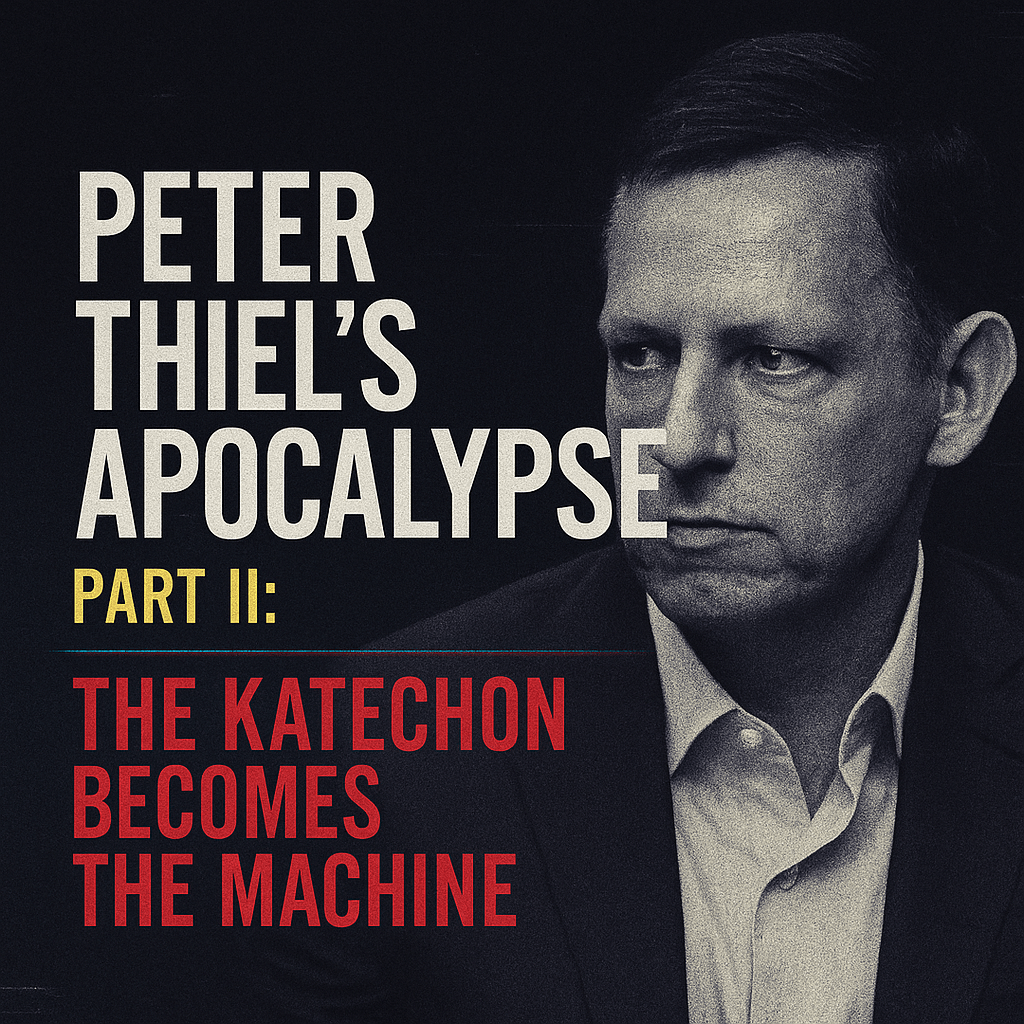
Peter Thiel isn’t just dropping eschatological quotes to sound intellectual. He’s been workshopping a political theology of the apocalypse in front of packed lecture halls, warning that the Antichrist will arrive not as a monster but as a bureaucrat — a manager, a false peacemaker. The irony is brutal: the exact infrastructure he bankrolls looks like a dry run for the system he says he fears.
This is part two of the story: how the katechon — the restrainer that’s supposed to hold back chaos — mutates into the very machine of domination. And how Thiel’s network is already wiring the restrainer.
⸻
the katechon as doctrine
- Biblical root: In 2 Thessalonians, Paul writes that something — the katechon — restrains the Antichrist from being revealed. It’s a mystery force, debated for centuries: empire, church, law, even time itself.
- Thiel’s take: Don’t “immanentize” the katechon. Don’t try to turn the restrainer into a worldly institution. Why? Because once you lock it into code, contracts, or states, it flips. The katechon becomes the Antichrist.
- His public line: the most dangerous thing isn’t just Armageddon — nukes, AI, climate collapse — it’s the panic response that justifies total surveillance in the name of order.
⸻
the empire of restraint
- Palantir: marketed as a restrainer — preventing terror, stopping crime, predicting pandemics. That’s the katechon logic: hold back chaos with data. But it’s also the exact machine Thiel warns about — “monitor every keystroke everywhere.”
- Anduril: pitched as restraining threats at the border, restraining adversaries with autonomous drones, restraining instability through tech deterrence. Yet the same towers and drones are the skeleton of automated policing states.
- Project 2025: advertised as restraining “deep state” chaos — but it centralizes executive power into a single apparatus. It restrains by concentrating authority, which is the very condition for authoritarian collapse.
⸻
antichrist mechanics in real time
Thiel’s theology of the Antichrist reads like a checklist against his own portfolio:
- Promise of peace and safety → Palantir dashboards marketed to protect society.
- False savior in technocratic garb → Anduril systems pitched as smart, humane deterrents.
- Fear of Armageddon as leverage → AI “doom” rhetoric softening the public for extreme surveillance.
- Katechon hard-coded into governance → Project 2025 wiring the restrainer into law.
By his own framework, the Antichrist doesn’t storm in with horns; he arrives through incremental upgrades, dashboards, contracts, and speeches about protection.
⸻
the feedback loop
Here’s where it gets sharp:
- Rhetoric: Thiel talks apocalypse, teaching elites to think in end-times categories.
- Capital: his money builds the tools to make those categories real in practice.
- Politics: his candidates push fear and order in the same breath.
That’s how the katechon becomes the machine — not in theory, but in infrastructure that already runs immigration control, defense contracts, and executive planning.
⸻
the curious close
Thiel warns about the Antichrist. But the scaffolding of his empire is indistinguishable from the scaffolding of that prophecy: surveillance, drones, executive concentration, predictive governance.
Maybe that’s the truest apocalyptic paradox. He’s not holding it back. He’s building it faster.
⸻
 A Curious Stack
Leave a comment