introduction
Peter Thiel likes to play prophet. He is not just the PayPal billionaire or the Palantir puppeteer; he’s a man who openly threads christian theology into his worldview. He invokes the apocalypse as if it’s not just scripture but a strategic lens. Thiel speaks of the antichrist the way a systems theorist might sketch a model: a false savior who sells “peace and safety” while setting the stage for domination.
But here’s the rub. Thiel’s actual business moves—Palantir’s surveillance grids, Anduril’s autonomous war machines, his bets on crypto enclaves and political strongmen—look less like resistance to the beast and more like a rehearsal for it. The rhetoric says defend the west from collapse. The portfolio says build the tools to manage collapse.
⸻
thiel’s religious language
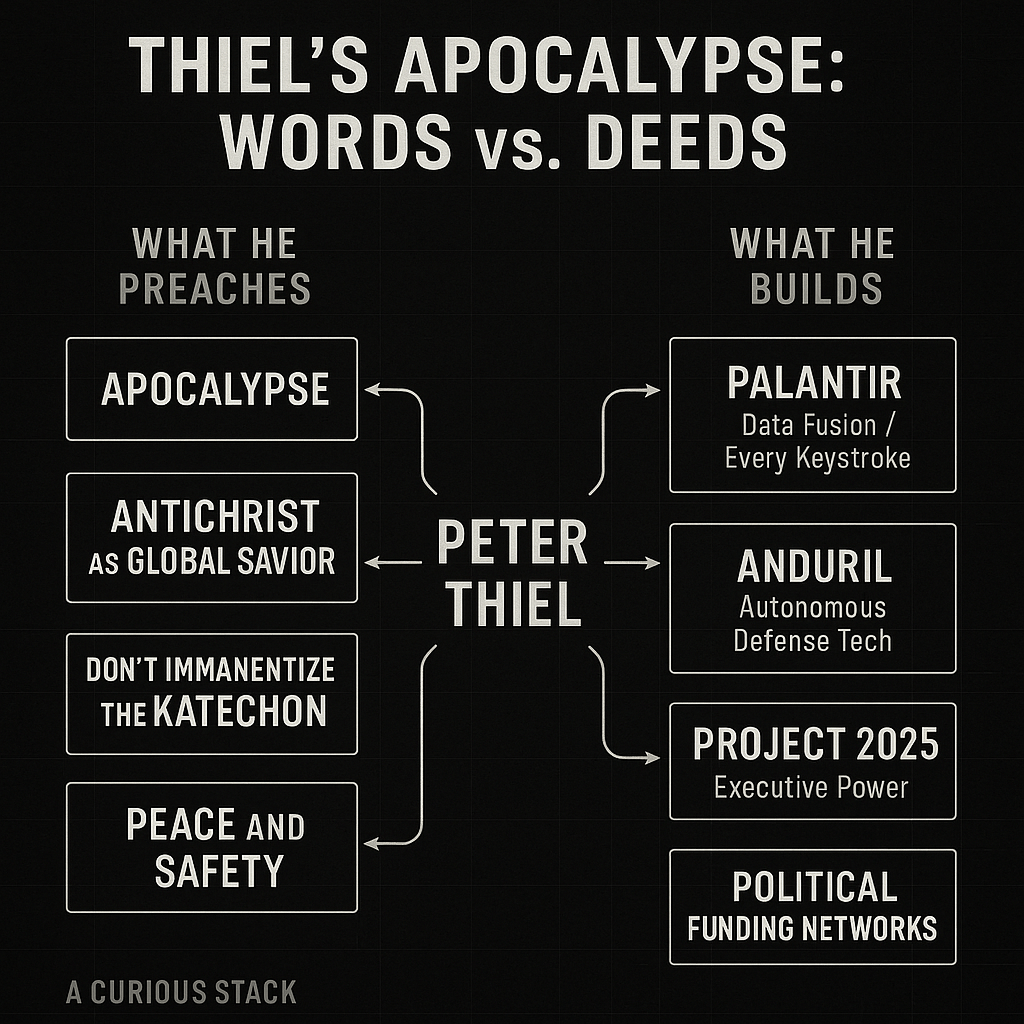
- Apocalypse as pattern recognition: in his lectures and interviews, Thiel frames biblical end-times visions as early warnings of technological catastrophe. Nuclear weapons, pandemics, runaway AI—he slots them into the old prophetic scaffolding. (Hoover Institution 2024; UnHerd 2025 analysis)
- The antichrist as system: citing Vladimir Solovyov’s Short Tale of the Antichrist and Robert Hugh Benson’s Lord of the World, he warns that the antichrist doesn’t come waving a pitchfork. he comes as a counterfeit Christ—promising global unity, efficiency, peace. (Hoover Institution transcript)
- The katechon dilemma: Thiel leans on a Pauline concept: the katechon, the restraining force holding back chaos. But he cautions—try to embody the katechon politically, and you risk becoming the very thing you fear. (UnHerd 2025)
- Existential risk vs. global tyranny: he’s said straight up that a one-world surveillance state would be as catastrophic as nuclear annihilation or an AI gone rogue, maybe worse. And yet he keeps returning to that image of total control. (Conversations with Tyler 2024)
“The slogan of the Antichrist is ‘peace and safety.’”
– Peter Thiel, quoting 1 Thessalonians 5:3
the empire in practice
- Palantir: built on CIA seed money, now woven through the Pentagon, the NHS, ICE, and dozens of government agencies. Its software integrates financial records, immigration files, and surveillance data—exactly the “every keystroke everywhere” apparatus thiel warned about. (Washington Post; FedScoop 2025)
- Anduril: the defense startup Thiel bankrolls builds AI-enabled sentry towers along the U.S.–Mexico border and autonomous drones like the Ghost and Roadrunner. That’s not resisting technocratic power—it’s supplying it with teeth and wings. (FT)
- Politics: he poured millions into Trump in 2016, then into hard-right figures like J.D. Vance. He bankrolls The Heritage Foundation’s Project 2025, which openly envisions a centralized executive reshaping the U.S. bureaucracy. (ft.com)
⸻
the contradiction
Thiel says he fears the antichrist will be a one-world surveillance empire. then he funds the companies building surveillance empires. He invokes the katechon, warning against systems that claim to restrain chaos, yet his own ventures sell governments the tools to monitor, predict, and control populations at planetary scale.
Is this hypocrisy, or is it something sharper? A Gen X eye might see a man dressing his ambitions in eschatological language — preaching about apocalypse while investing in the gears of a system that could make “apocalypse management” a profit center.
⸻
the curious closing
Religion gives Thiel’s politics a prophetic gravity. But when the sermon is measured against the balance sheet, the picture twists: the man warning about an antichristian technocracy is financing the very infrastructure that could look like one.
Maybe the end times aren’t an accident he fears. maybe they’re the business plan.
⸻
Stay curious.
⸻
 A Curious Stack
Leave a comment