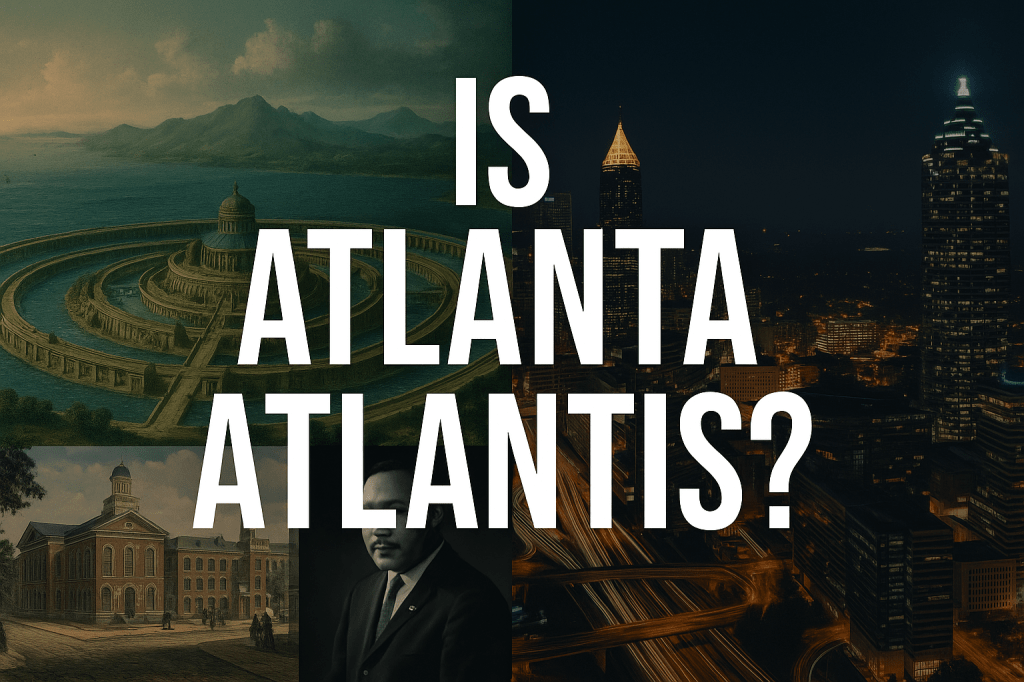
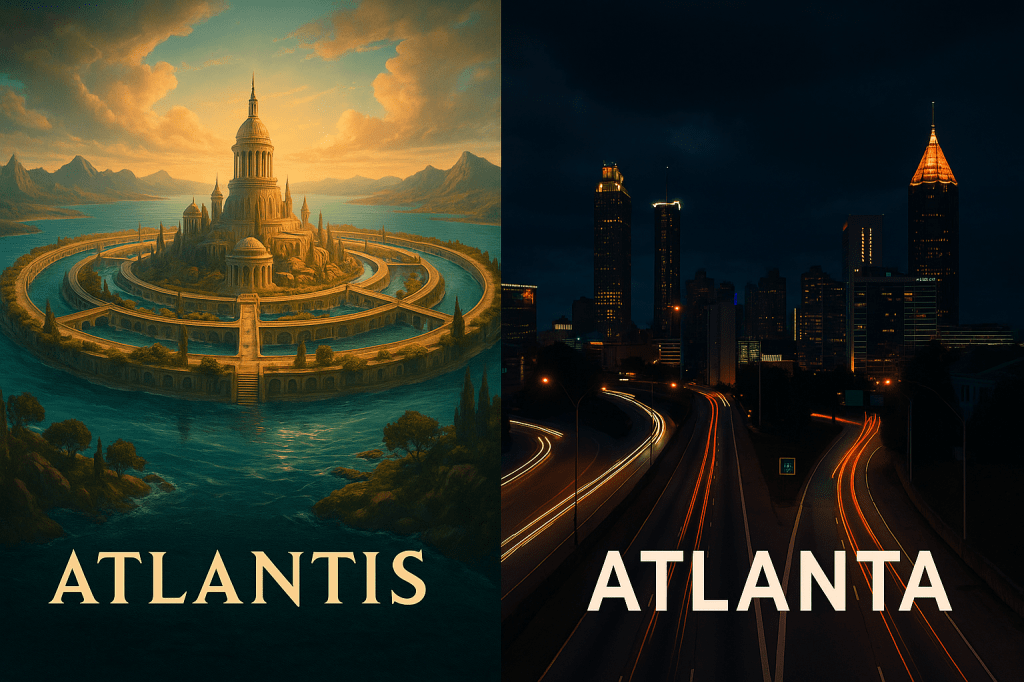
Atlantis has always been less of a place and more of a mirror. Plato gave us the story twenty-four centuries ago: a mighty island empire, swallowed by the sea in “a single day and night of misfortune.” Scholars still argue if he meant history, allegory, or both. But the real staying power of Atlantis is that people keep seeing it everywhere. It gets projected onto coastlines, ruins, even city streets.
Some say it’s here. In Georgia. That Atlanta is Atlantis reborn.
⸻
the name that refuses to be coincidence
Atlanta. Atlantis. The difference is a syllable or a slip of the tongue. For believers, that’s no accident. Names carry memory, and memory carries power. In the mythic imagination, Atlanta’s very name is a breadcrumb trail back to the drowned world. If you believe history works in echoes, the phonetic rhyme is a clue. It’s the ghost of Atlantis reasserting itself in plain daylight, hiding in the naming of a city that would one day rise to power.
Even skeptics feel the tug. Words sound alike because humans want them to, because language bends toward story. The name makes the link irresistible. You say “Atlanta” enough and “Atlantis” hovers right there, just beneath it, like a reflection in water.
⸻
phoenix city, drowned city
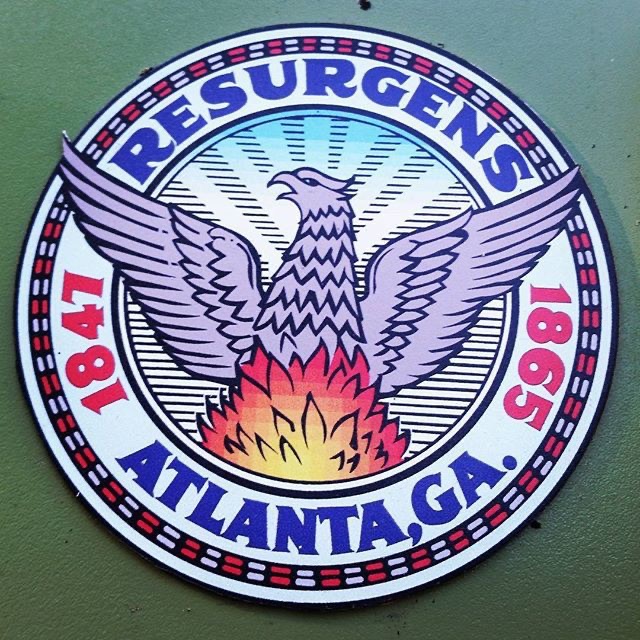
Atlanta was born a rail hub in 1837, a dot on a map where tracks converged. Within a generation it was burning. The city was torched by Sherman’s Union troops in 1864, and reduced to ash as the Confederacy’s capital of resistance. That destruction became the city’s myth of origin. Out of the fire came rebirth, a new city rising on the ashes. Atlanta chose the phoenix as its symbol, a reminder that its whole identity is built on death and resurrection.
Atlantis, too, is a story of destruction and memory. A mighty place wiped away by water. In both myths, the city vanishes violently, and what comes after is only the story pieced together from the ruins.
Atlanta’s official seal literally shows the phoenix mid-flight, forever reborn from flame. Believers see this not as coincidence but as continuation. Atlantis drowned. Atlanta burned. Both cities teach the same lesson: catastrophe isn’t the end.
⸻
circles and tunnels
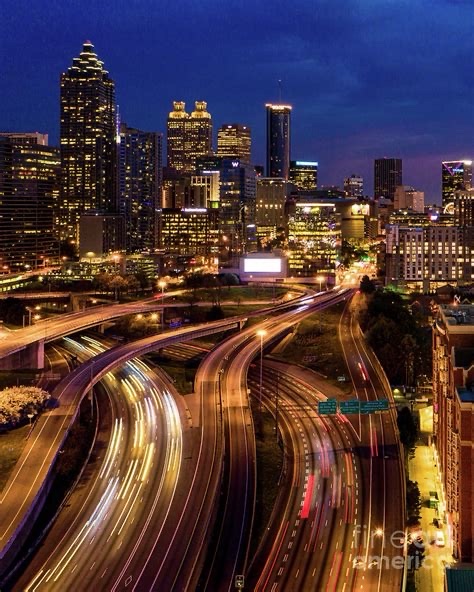
Plato described Atlantis as rings: concentric circles of land and sea. Power radiating outward in ordered geometry. For some, Atlanta’s layout mirrors the pattern. Its interstate highways, including I-285 and the loops feeding into it, carve the city into rings. At the core, a hub of glass towers and stadiums. Outside, belts of asphalt radiating like the ancient canals of Plato’s island.

Beneath those circles lies the city’s other layer: the tunnels. Atlanta’s underground stretches beneath downtown and includes abandoned malls, sealed subway entrances, and whispers of forgotten passageways. Then there’s the airport, Hartsfield-Jackson, the busiest in the world, wrapped in conspiracy. The murals that show apocalyptic imagery, and the rumors of deep tunnels, secret bunkers, and FEMA staging areas. Believers fold all of this into the myth. To them, the city’s underworld is the Atlantean remnant, the hidden infrastructure of an older, stranger power.
⸻
waves of culture, waves of power
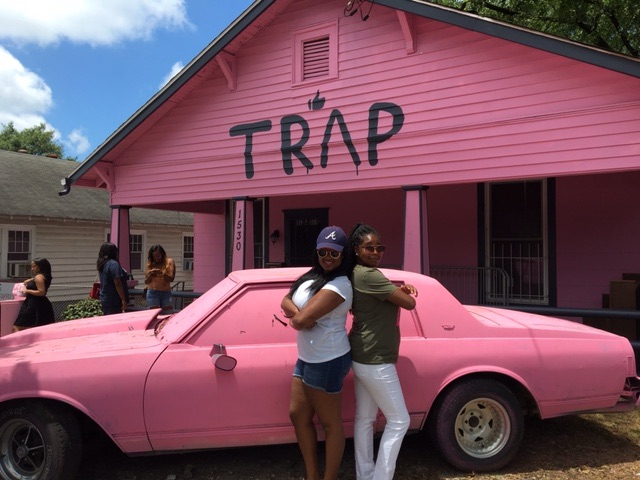
Atlantis was imagined as an empire that shaped whole oceans, projecting power across the known world. Atlanta plays that role in our time, not with ships but with sound. The city remade American music, birthing hip hop giants, Outkast’s cosmic funk, the trap beats that now underpin global pop. Culture radiates out of Atlanta like tidal waves that are invisible but undeniable, rolling across continents.
Atlanta is film sets, Fortune 500 headquarters, data vaults at the CDC, stadium spectacles that beam across the planet. It’s a city that has mastered the projection of influence. Atlantis survives in memory as an empire of influence, not as a dot on any map. In that sense, Atlanta is Atlantis already: not a place lost, but a place broadcasting its myth outward in real time.
⸻
submerged histories
Atlantis is remembered as a city lost to the sea, but water isn’t the only way to drown memory. Atlanta’s past is layered with submerged histories. They’re stories drowned beneath progress.
- Built on land taken from the Muscogee (Creek) Nation.
- Expanded on the labor of enslaved people.
- Reshaped after the fire of the Civil War, then again during Jim Crow segregation.
- Entire Black neighborhoods later erased in the name of urban renewal and highway construction.
Atlantis was lost in a single night. Atlanta loses itself piece by piece, covering old scars with new skylines. Beneath the polished cityscape lie histories that were never properly grieved, never fully told.

To call Atlanta Atlantis is to point toward the currents that move beneath the visible city. The skyline rises in steel and glass, but the ground remembers. It remembers the fires that once consumed it, the stories cut from the record, the lives erased from its maps.

Atlantis was said to vanish into the ocean. Atlanta carries its own form of submersion, not water but history, with hidden chapters that still pull at the surface.
⸻
the myth that never dies
So is Atlanta literally Atlantis? No archaeologist has uncovered sunken temples beneath Peachtree Street. No Bronze Age ruins lie hidden under the MARTA tracks. But that’s not the point. Atlantis has always been about more than location. It’s about hubris, collapse, the cycle of destruction and rebirth.
When people call Atlanta Atlantis, they’re tapping into a story older than maps. A city of fire instead of flood. A phoenix instead of a drowned isle. A hub of culture and power carrying the same weight of arrogance and fragility Plato warned us about.
Maybe Atlanta is Atlantis because it doesn’t matter where the island sank. It matters that empires fall, myths return, and cities are never just cities. They’re archetypes, mirrors, warnings.
The only real question is how long before the waters, or the fires, come again.
⸻
 A Curious Stack
Leave a comment