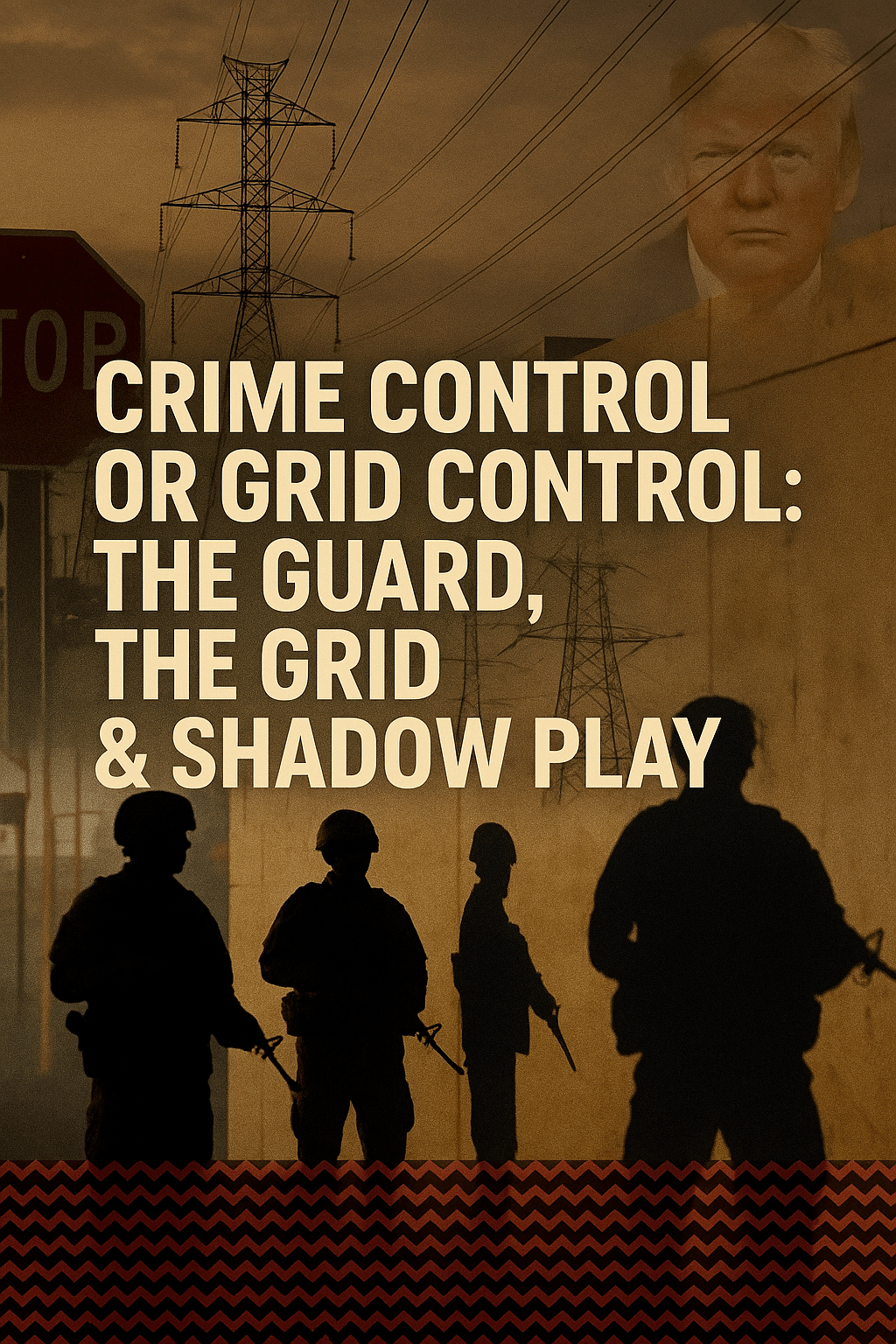
The headline is clean: Trump is sending National Guard units into 19 states for “crime control.” The footage looks like a throwback to the 60s — troops on city streets, Humvees parked outside strip malls, flags flying. But scratch the surface, and you see something else.
The Guard isn’t being sent just to crime-plagued neighborhoods. They’re being planted along the arteries of the most fragile system in America: the electrical grid. And once you add in the deployments everyone already knows about — Washington, D.C. and Los Angeles — the picture changes.
This power play is taking control of the collapse. And when collapse comes, it isn’t just governments who benefit. It’s private actors like Peter Thiel — men whose fortunes are welded to crisis itself.
⸻
the grid: america’s soft underbelly
The U.S. grid is the biggest machine in the world — and one of the weakest. It isn’t a single unified system but three:
- Eastern Interconnection – runs from the Midwest to the East Coast, covering two-thirds of the population.
- Western Interconnection – stretches across huge distances with brittle redundancy.
- ERCOT (Texas) – a standalone island grid, already infamous for its deadly 2021 collapse.

The numbers sound big — 7,300 power plants, 160,000 miles of high-voltage lines — but the system is rickety. Many transformers are 40–60 years old. Critical parts are custom-built and take years to replace. Fuel for natural-gas plants runs “just-in-time” through pipelines that freeze, rupture, or bottleneck.
DHS and FERC have both admitted: if attackers hit as few as nine critical substations, cascading failures could take down the entire nation. That report was leaked in 2014 and classified after. The weakness is not speculation. It’s documented.
⸻
the 19 states — plus the 2 already covered
The Guard is officially rolling into:
Alabama, Arkansas, Florida, Georgia, Idaho, Indiana, Iowa, Louisiana, Nebraska, Nevada, New Mexico, Ohio, South Carolina, South Dakota, Tennessee, Texas, Utah, Virginia, Wyoming.
But that’s not the full picture. The Guard is already entrenched in Washington, D.C. (the federal command center) and Los Angeles (the West Coast’s load center and shipping hub).

That makes it 21 jurisdictions with Guard forces in play. Put them on a grid map and the overlaps pop out:
- Texas / ERCOT – the weakest grid in the country. Guard here doubles as energy insurance.
- Gulf Corridor (Texas, Louisiana, Arkansas) – pipelines and refineries feeding the nation. Knock them and the grid starves.
- Midwest (Nebraska, Indiana, Ohio, Iowa) – transmission chokepoints that cascade into the Eastern Interconnection.
- Southeast (Georgia, South Carolina, Virginia, Florida) – hurricane-prone, aging infrastructure, high-demand corridors.
- Mountain West (Idaho, Utah, Wyoming, Nevada, New Mexico) – Western Interconnection’s thinnest links.
- D.C. and L.A. – the political brain and the economic port, already secured.
⸻
collapse as strategy
Here’s the part nobody likes to say out loud: collapse isn’t always something the powerful fear. Sometimes it’s something they manage.
- Crisis breeds obedience. When the grid dies, people beg for order. Martial law stops being a nightmare scenario and becomes the only functioning option.
- Selective outages = selective control. Blackouts don’t have to be nationwide. Cut power in one region, keep it on in another, and you can choke dissent, redirect migration, or even control elections.
- Economic leverage. No power means no banking, no fuel, no food distribution. The state decides who eats, who moves, who gets medicine.
- Permanent normalization. Once troops are embedded in grid corridors under “crime control,” that presence becomes permanent. The extraordinary turns ordinary.
The Guard map looks like a net cast around the grid — forces already standing at chokepoints when the system cracks.
⸻
thiel’s shadow position
This is where Peter Thiel enters. For regular people, collapse means chaos: dry taps, spoiled food, hospitals failing, cities unlivable in two weeks.
For Thiel, collapse is business.
Palantir and crisis capitalism
- Palantir exists to sell governments “predictive control” in chaos.
- Every riot, every blackout, every wave of migration = another federal contract.
- The more fragile society feels, the more indispensable Palantir becomes.
But doesn’t Palantir need the grid too?
Yes — Palantir runs on servers, which need power. But Palantir doesn’t host its own racks in strip malls. It runs on AWS GovCloud, Azure Government, and Pentagon data networks — all of which are hardened with backup systems:
- Onsite diesel and natural-gas generators.
- Battery banks.
- Microgrids tied into military installations.
- Priority status under federal continuity-of-government rules.
When hospitals go dark, those government-grade centers are still lit. When your fridge dies, their servers hum.
Alternate energy channels
Thiel has investments — directly and through networks — in small modular nuclear reactors, AI-optimized grid projects, and private solar/microgrid plays. The man isn’t betting on the public grid. He’s betting on parallel infrastructures that survive collapse.
⸻
why collapse benefits the elite
For the working class, collapse is lethal. For billionaires, it’s leverage.
- Shock resets expectations. After blackouts, even half-measures feel like miracles.
- Depopulation without bullets. System failure kills the poor first, and the powerful keep their hands clean.
- Consolidation of control. Crisis squeezes out small players. The Pentagon won’t turn to a scrappy startup in chaos. It will turn to Palantir.
That’s how collapse becomes a feature, not a bug.
⸻
bottom line
The official line is crime control. The visible posts are D.C. and L.A. The new map is 19 states spread across refinery corridors, transmission chokepoints, and fragile interconnections.
Put it together, and you don’t see policing. You see infrastructure chess — Guard forces anchoring the weak points of the grid, while crisis-capital firms like Palantir wait in the wings to monetize the fallout.
Collapse doesn’t scare the powerful. It cements their leverage. When the lights go out, the Guard won’t be chasing carjackers. And Palantir won’t be scrambling to reboot. They’ll both already be at the switch.
Stay curious.
Next up: a grid-down survival guide. Stay tuned.
 A Curious Stack
Leave a comment