

Most billionaires want their names on buildings or their faces on magazine covers. Peter Thiel built his power differently. He doesn’t need celebrity status, because influence works better in the shadows. Thiel operates like a systems engineer of politics — wiring money, ideology, and technology into the places where decisions get made and populations get managed.
He isn’t running for office. He doesn’t need to. His companies supply intelligence agencies and militaries. His checks put hand-picked candidates into Congress. His philosophy — openly hostile to democracy — has bled from fringe corners of the internet into the mainstream of American politics. While the headlines follow Trump rallies and culture wars, Thiel is embedding his worldview into the machinery of governance.
To understand him, you have to trace the arc: a childhood under apartheid, a Stanford education steeped in libertarianism, an early fortune from PayPal, and the founding of Palantir — the surveillance backbone now used by governments around the world. The throughline is power: how to acquire it, how to protect it, and how to insulate it from democracy itself.
⸻
childhood under apartheid
Peter Andreas Thiel was born in Frankfurt, Germany, in 1967. His family moved often — first to Cleveland, then to South Africa in the 1970s, before finally settling in Silicon Valley.
South Africa under apartheid was a country ruled by a white minority elite through violence, bureaucracy, and constant surveillance. Thiel attended school in that system, watching how majorities were treated as threats to be controlled. He later called that period “unstable” and formative. Look at his worldview today and you see the echo: suspicion of democracy, fascination with elite protection, and an instinct for control through systems.
Back in California, he absorbed the libertarian currents of 1980s Silicon Valley. At Stanford he co-founded The Stanford Review, a conservative-libertarian campus paper. By the time he graduated, his philosophy was clear: freedom belonged to elites, and democracy was something to be constrained.
⸻
from paypal to palantir
In 1998, Thiel co-founded PayPal, one of the first major online payment systems. When eBay acquired it for $1.5 billion in 2002, he walked away with a fortune and the leverage to expand his reach.
Two years later, he became the first outside investor in Facebook, writing Mark Zuckerberg a $500,000 check that turned into over a billion dollars.
His most consequential project began in 2003: Palantir Technologies, launched with backing from In-Q-Tel, the CIA’s venture arm. Palantir was built to make sense of massive data sets for intelligence agencies. In practice, it became software that maps networks of people, tracks movements, and predicts behavior.
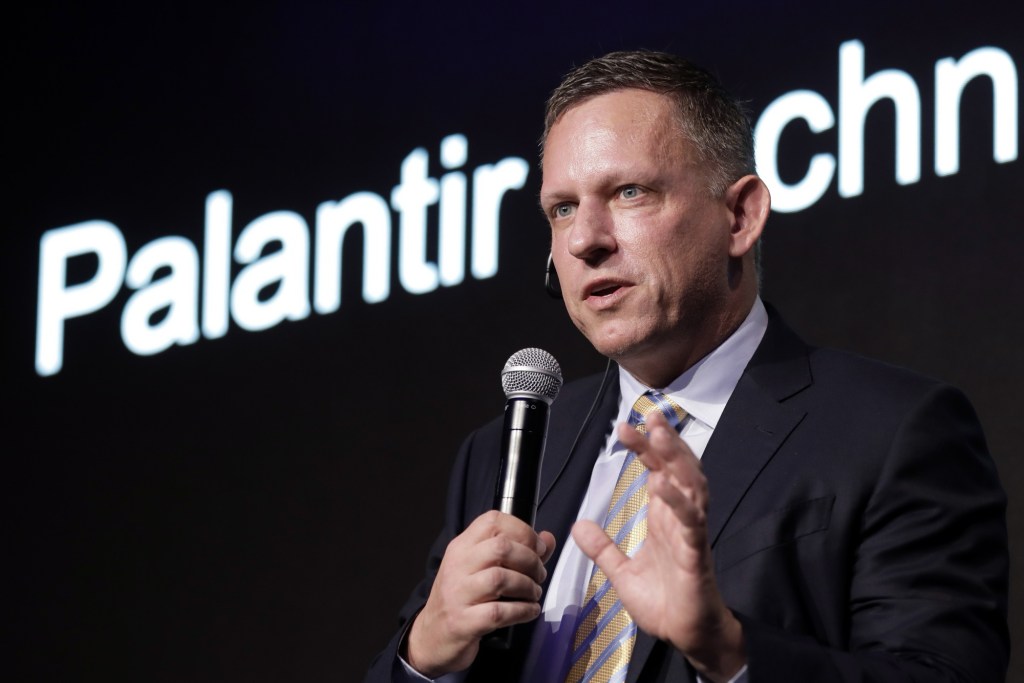
Palantir was soon embedded in the CIA, NSA, ICE, local police, and militaries around the world. Thiel had moved from tech investor to architect of the surveillance state.
⸻
the ideology: freedom for elites, disdain for democracy
Thiel doesn’t hide his politics. In 2009, he wrote:
“I no longer believe that freedom and democracy are compatible.”
That line is the core of his philosophy. He sees democracy as mob rule that slows progress and constrains elites. His version of freedom is the right of capital and technocrats to act without restraint.
His contempt for democracy has always been tied to cultural resentment. In the same 2009 essay, Thiel argued that women gaining the right to vote helped bring about what he called the “decline” of political freedom. In his view, universal suffrage pulled politics toward welfare, irrational decision-making, and redistribution — exactly the things he wanted protected elites insulated from.
This wasn’t new. At Stanford in the 1980s, Thiel co-founded The Stanford Review largely to attack what he called “political correctness” — student movements for racial and gender equality. That hostility carried forward. Today, he rails against “woke politics” the same way he once railed against multiculturalism. For Thiel, feminism, diversity, and social justice aren’t progress but obstacles to innovation and elite control.
These ideas put him close to the Dark Enlightenment, a neo-reactionary movement built by philosopher Nick Land and blogger Curtis Yarvin (Mencius Moldbug). They argue democracy is a failed experiment that should be replaced with authoritarian, corporate-style rule. Yarvin envisions a patchwork of city-states run like corporations; Land calls for acceleration toward elite domination.
Thiel doesn’t wear their label, but his moves track their logic:
- He funded seasteading projects to build private colonies outside democratic law.
- He bankrolled politicians like Blake Masters and J.D. Vance, who parrot Yarvin’s critiques of democracy and rail against “woke capital.”
- He openly linked women’s suffrage to the decline of freedom, a claim that reveals the reactionary heart of his philosophy.
From Stanford pamphlets to billion-dollar contracts, Thiel has been consistent: democracy empowers the wrong people, and the future should be built for elites alone.
⸻
building the machine
Thiel’s companies embody his worldview.
Palantir: used for predictive policing, deportation raids, counterterrorism, and financial surveillance.
Anduril: founded by Palmer Luckey with Thiel’s backing, produces autonomous drones, surveillance towers, and Lattice, an AI system that merges sensor feeds into real-time battlefield command.
Together they make up the infrastructure of predictive governance: societies managed not through debate but through algorithms and surveillance. Arrests, deportations, and military decisions increasingly depend on systems tied to Thiel.
⸻
politics: the kingmaker
In 2016, Thiel broke from Silicon Valley’s liberal mainstream and backed Donald Trump. He donated millions, spoke at the Republican National Convention, and became a bridge between tech capital and right-wing politics.
Since then he has positioned himself as a financier of the GOP’s authoritarian wing:
- J.D. Vance owes his Senate seat to Thiel’s millions.
- Blake Masters ran in Arizona as Thiel’s protégé, parroting Yarvin-inspired lines about democracy’s failure.
- Thiel continues to seed PACs and think tanks driving nationalist and anti-democratic agendas.
Thiel prefers influence to attention. The politicians he installs and the networks he funds keep working long after his name drops out of the news.
⸻
the gawker takedown
Thiel’s hostility toward democracy extends to the press. In 2007, Gawker Media outed him as gay and continued publishing biting critiques of Silicon Valley elites. Thiel spent nearly a decade plotting revenge.
He secretly financed lawsuits against Gawker, culminating in Hulk Hogan’s case over a leaked sex tape. Thiel quietly bankrolled Hogan’s legal team until the verdict bankrupted Gawker in 2016.
It wasn’t only about payback. It was proof of how a billionaire can eliminate critics without engaging them in public debate. The Gawker takedown revealed his style of power: long-term, strategic, and devastatingly effective.
⸻
the epstein shadow
Thiel’s career has always crossed with networks that operate outside public view. The most unsettling example is Jeffrey Epstein.
Epstein invested in tech ventures through Valar Ventures, a Thiel-backed fund, channeling money into fintech startups like Wise, Xero, N26, and Bitpanda. Those investments were structured in ways that shielded them from lawsuits, making the capital nearly untouchable.
Meeting records also place Epstein with Thiel after Epstein’s 2008 conviction. What was discussed isn’t public, but the overlap shows how Epstein attached himself to powerful men in tech and finance — and how Thiel’s orbit intersected with that world.
The connection doesn’t make Thiel complicit in Epstein’s crimes, but it illustrates a pattern: Thiel is comfortable in ecosystems where secrecy, money, and leverage converge. Palantir and Anduril handle that through contracts and code. Epstein handled it through finance and kompromat. Both represent structures of control operating outside democratic accountability.
⸻
the pursuit of immortality
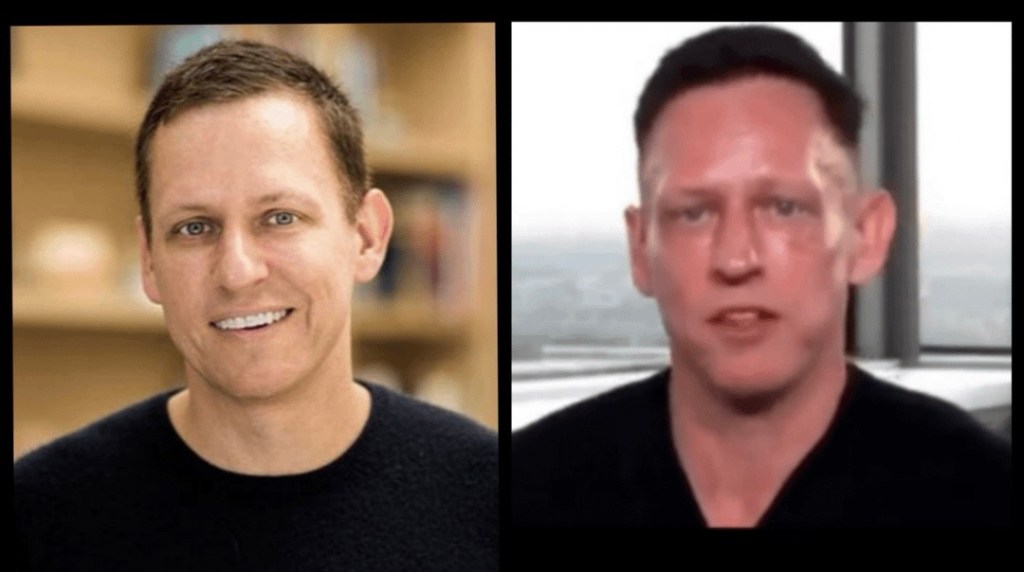
For Thiel, politics and technology are only part of the story. He has also poured millions into life extension and transhumanist projects — cryonics, parabiosis experiments that test whether young blood transfusions can slow aging, and biotech ventures chasing cellular rejuvenation. He’s linked himself to cryonics outfits like the Alcor Life Extension Foundation, where the bodies of believers are frozen in the hope of a future revival.
The pattern is consistent with the rest of his worldview. Thiel treats death the same way he treats democracy — as a constraint to be engineered around. Mortality isn’t just biology to him, it’s a barrier to the continuity of power. Extra decades mean compounding wealth, more time to direct capital and politics, and a longer window to embed his philosophy into the systems that govern society.
His investments have included:
- Methuselah Foundation, backing anti-aging research.
- Unity Biotechnology, targeting senescent cells.
- Ambrosia, the controversial blood-plasma startup.
- Cryonics initiatives such as Alcor.
Thiel’s money in anti-aging and cryonics follows the same logic that runs through his politics and technology. Mortality becomes another system to hack, another obstacle to sidestep. By buying time, he buys reach — wealth that stretches further, influence that carries across generations, and the possibility of shaping the future long after most of his contemporaries are gone.
⸻
why he matters now
The U.S. is entering a period of instability — economic volatility, climate breakdown, authoritarian politics. Thiel’s influence fits that moment.
- Project 2025 envisions a consolidation of executive power, and Thiel’s companies are positioned to provide the enforcement.
- Governments across the world are adopting Palantir and Anduril systems to manage migration, dissent, and resources.
- Dark Enlightenment ideology, once obscure, now shapes mainstream GOP platforms through Thiel’s protégés.
Thiel doesn’t need elected office. His power comes from embedding his worldview into code, contracts, and political infrastructure that outlast administrations.
⸻
the bottom line
Peter Thiel is a billionaire philosopher who rejects democracy. He bankrolls politicians who want to dismantle it. He builds the surveillance tools that governments rely on to manage populations. He destroyed a media outlet that exposed him, and his world intersected with Epstein’s networks of capital and secrecy. He’s argued that women’s suffrage weakened freedom, and he rails against “woke” politics with the same hostility he once aimed at campus multiculturalism.
He matters now because his influence is structural. While the public is distracted by the circus of elections, Thiel is hardwiring a future where democracy is sidelined — replaced by data, surveillance, and the rule of elites.
⸻
Stay curious. Stay woke. Stay safe. Get and stay prepared.
⸻
sources
Thiel, Peter. “The Education of a Libertarian.” Cato Unbound, April 2009. Link
Yarvin, Curtis (Mencius Moldbug). Unqualified Reservations archive. Link
Land, Nick. The Dark Enlightenment. 2012. Link
Palantir contracts with ICE and law enforcement: The Intercept, Dec 2020. Link
Anduril systems overview: Defense News, June 2023. Link
Thiel’s GOP influence and candidate backing: New York Times, Oct 2022. Link
Gawker lawsuits and takedown: Forbes, May 2016. Link
Epstein/Valar Ventures fintech investments: Wall Street Journal, Aug 2019. Link
Epstein’s meetings with Silicon Valley elites: New York Times, May 2021. Link
Biographical context, including South Africa: Business Insider, July 2022. Link
 A Curious Stack
Leave a comment