
IV – Eyes in the Sky, Code in the Trigger
Introduction
The sky is no longer empty.
What was once the domain of weather balloons and hobbyist aircraft has been transformed into a sovereign layer of permanent surveillance and autonomous targeting. It’s not just overseas anymore. The U.S. homeland—its borders, protests, rural communities, and city centers—is now under quiet watch by machines built for war.
This isn’t speculative, nor is it theoretical. The systems are already here—built by private firms, funded by defense contracts, and increasingly powered by algorithms that make life-and-death decisions without human hands on the trigger.
In Part IV of this series, we examine the drone infrastructure that underpins the coming technocracy. We trace the evolution from reconnaissance to targeted killing. From battlefield optics to predictive border enforcement. From watching to acting.
⸻
I. The New Aerial Architecture
From Surveillance to Lethality
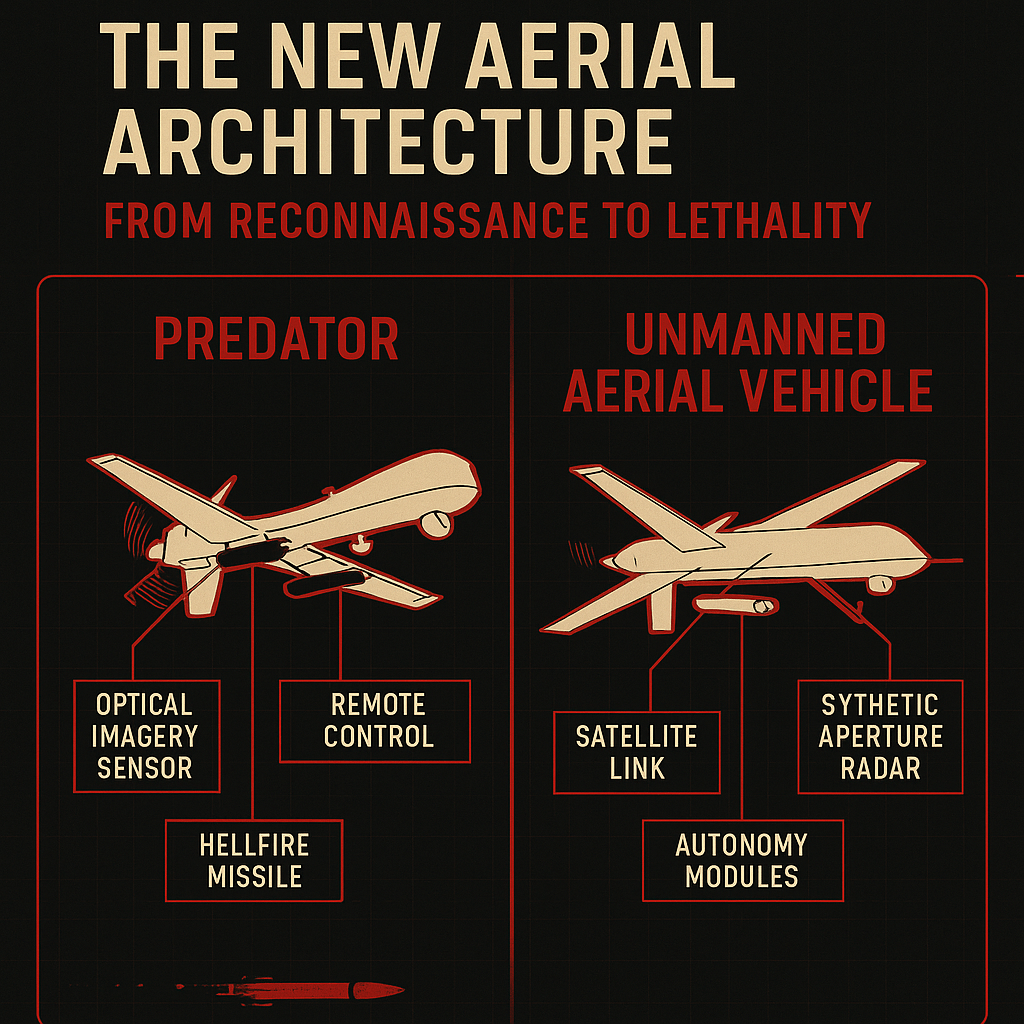
The modern drone is not a flying camera. It is a data node, a weapons platform, and an AI-guided sensor array capable of independent action. Companies like General Atomics and Anduril Industries are deploying aerial systems that blur the line between surveillance, deterrence, and execution.
General Atomics – Predator Legacy
• The MQ-1 Predator, and its successor the MQ-9 Reaper, were developed by General Atomics Aeronautical Systems, Inc.
• Equipped with Hellfire missiles, these UAVs were used for “targeted strikes” in Iraq, Afghanistan, Yemen, Pakistan, and Somalia.
• Civilian death tolls from these strikes remain contested, but independent reports estimate hundreds to thousands of civilian casualties—including children.
Although the MQ-1 has been retired, its successors remain active, upgraded, and increasingly autonomous.
⸻
II. Anduril: The Rise of Domestic Drone Governance
Founded by Palmer Luckey and funded by Peter Thiel, Anduril Industries has positioned itself as a critical vendor in the next phase of militarized surveillance. Unlike the legacy defense contractors, Anduril designs its systems around real-time autonomy, persistent monitoring, and AI-led decision loops.

Key Platforms:
• Ghost – A long-range ISR drone designed for reconnaissance in contested or remote environments. Can loiter for hours and identify targets without GPS.
• Roadrunner & Roadrunner-M – AI-enabled interceptor drones capable of launching, identifying aerial threats, and physically intercepting them without direct operator control.
• ALTIUS-600M – A loitering munition (kamikaze drone) capable of autonomous strike missions.
• Bolt-M – A man-portable VTOL drone that can carry munitions and integrate into Anduril’s Lattice AI command platform for autonomous targeting and strike approval.
⸻
III. The Domestic Front: Surveillance of the U.S. Population
Border as Testbed
Over 300 Anduril Sentry Towers now line the U.S.-Mexico border. These autonomous towers, powered by solar and AI, use radar, thermal cameras, and machine learning to detect and track human movement. They are fully integrated with Anduril’s Lattice platform and feed directly into Customs and Border Protection (CBP) command centers.
‼️‼️The Fourth Amendment does not fully apply within 100 miles of any U.S. border—effectively turning the southern U.S. into a constitutional gray zone where AI-led surveillance operates with little judicial oversight.
Protest and Civil Monitoring
While officially not deployed for protest surveillance, the capabilities of platforms like Ghost, Bolt, and the Lattice command system are transferable to domestic crowd monitoring, behavioral pattern recognition, and predictive threat detection—especially in emergencies, under National Guard deployments, or when DHS is granted expanded powers.
⸻
IV. Lethal Autonomy: From Kill Lists to Code
Gaza as the Testbed for AI Warfare
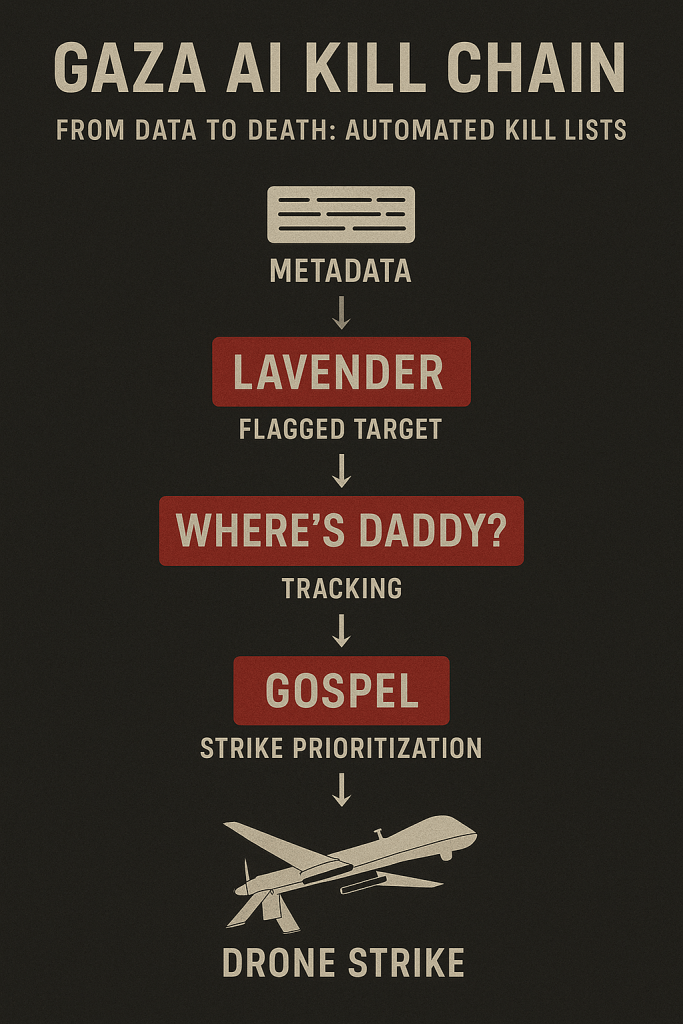
Investigative reports by +972 Magazine, Middle East Eye, and Democracy Now! confirm that the Israeli military has used multiple AI platforms to generate automated kill lists. These include:
• Lavender – AI software that flagged up to 37,000 Palestinians as kill targets based on predictive models and metadata.
• Where’s Daddy? – A system used to track flagged individuals to their homes to time airstrikes while they’re present—often including family members.
• Gospel – Used to prioritize strike locations and match suspected militant movements to real-time drone footage.
While Palantir (another Thiel-backed firm) has denied involvement in Lavender specifically, its longstanding contracts with IDF intelligence and U.S. Special Operations suggest the same architecture—metadata fusion, AI modeling, and predictive targeting—runs across allied systems.
Loitering Munitions and Ghost Warfare
The Altius-600M, now supplied to Ukraine and used in defense contracts with NATO members, is a loitering munition—a drone that can autonomously circle an area until it detects a strike-worthy target, then self-destruct on impact. The lethality is delegated to algorithms trained on battlefield signatures.
This same platform is being adapted for homeland counter-UAS missions. But the dual-use threat is obvious: once deployed, the only limitation on kinetic action is software configuration—not physical capability.
⸻
V. Domestic Implications: What These Drones Can Do to U.S. Citizens
While U.S. law prohibits domestic drone strikes (for now), the infrastructure for automated surveillance and lethal enforcement is already in place. These platforms can:
• Track movement persistently without human pilots
• Recognize faces, behaviors, heat signatures, and “pattern of life” anomalies
• Integrate with social media and communication metadata
• Operate with minimal human oversight under emergency exceptions
• Be armed, tested, and ready to shift rules of engagement with software toggles
The tech is here. The legal frameworks are being eroded. And the historical pattern is clear: military tools rarely stay overseas.

⸻
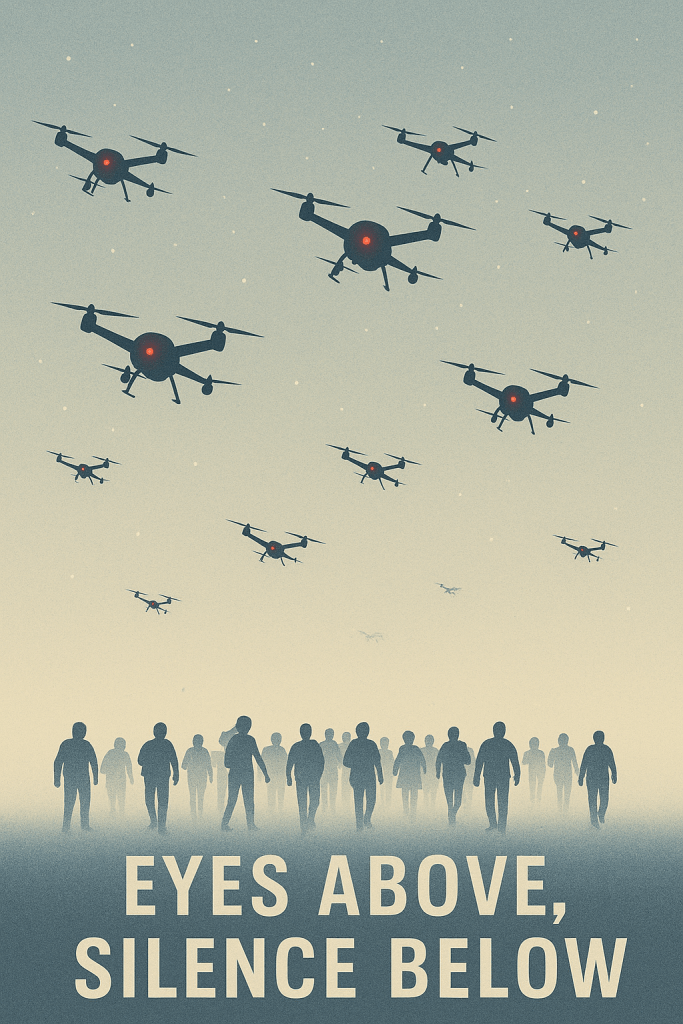
Conclusion : Eyes Above, Silence Below
The coming technocracy will not announce itself with parades or campaigns. It arrives via procurement orders, quiet deployments, and software updates.
The drone is no longer a battlefield tool. It is a governance mechanism.
We are now subjects under observation—citizens managed by sensor networks, scored by AI, and tracked by silent machines that don’t need to ask questions before they act.
Part V will explore the Freedom Cities and Charter Governance Zones being built outside the democratic framework. From Honduras to Texas, the privatized state is being prototyped.
You won’t get to vote for what’s coming next. You’ll only be offered the terms of service.
Stay curious. Stay safe.
⸻
sources:
1. Anduril Deploys 300th Autonomous Surveillance Tower for CBP
2. EFF Maps CBP’s Expansion of Surveillance Towers at U.S.–Mexico Border
3. Ghost Autonomous sUAS – Anduril
4. Altius-600M Loitering Munition Overview – Anduril
5. Anduril Unveils Bolt and Bolt-M ISR and Munition-Capable Drones
6. Anduril’s Roadrunner-M Drone Interceptor Gets Expanded Pentagon Order – The War Zone
7. Business Insider – Full Overview of Anduril’s Drone Arsenal and AI Warfare Platform
8. Financial Times – Trump-Era Border Security Funds Bolster Anduril
 A Curious Stack
Leave a comment