
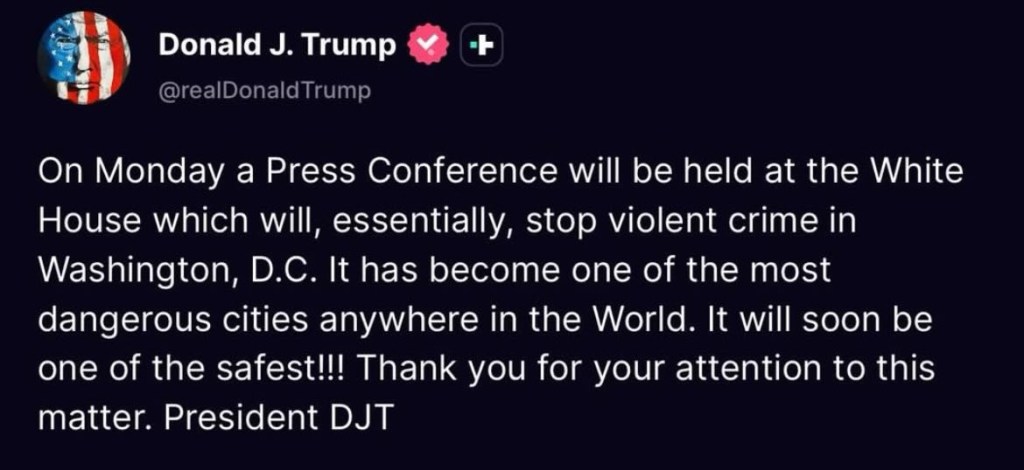
With a press conference scheduled for Monday, August 11, 2025, President Trump has said he will announce steps to “stop violent crime” in Washington, D.C.
Download a free PDF press conference tracker checklist below:
While the specifics are not yet public, recent federal actions in the city and statements from the administration suggest a possible incremental approach to increasing federal authority over the District without formally declaring martial law or repealing the Home Rule Act.
The following is a realistic, legally plausible sequence of actions based on existing authorities and recent developments.
⸻
Phase 1: Narrative and Initial Federal Presence
Approximate timeline: Week of August 11 → late August
Action: Continue framing D.C. as unsafe and unfit for self-governance, citing crime rates and alleged failures by local leadership.
Recent precedent: Federal law enforcement surge launched in early August involving Park Police, FBI, ATF, DEA, and other agencies patrolling tourist and high-traffic areas.
Legal basis: Federal agencies have full jurisdiction over federal property in D.C. and can patrol adjacent public areas in coordination with the Metropolitan Police Department (MPD).
Effect: Normalizes visible federal presence and establishes public expectation of further federal involvement.
⸻
Phase 2: Increased Federal Jurisdiction in Local Law Enforcement
Approximate timeline: Late August → September
Action: Cross-deputize federal officers to operate citywide, expand joint federal–local task forces, and shift certain prosecutions from D.C. Superior Court to U.S. District Court.
Legal basis: Memoranda of Understanding (MOUs) between agencies; U.S. Marshals can deputize officers; federal prosecutors can assume cases involving firearms, narcotics, or crimes on federal property.
Effect: Reduces the operational independence of MPD without altering formal governance structures.
⸻
Phase 3: Expansion of Federal Security Zones
Approximate timeline: October
Action: Designate additional “federal security zones” beyond existing areas like the National Mall. These zones could cover major transportation hubs, government buildings, and critical infrastructure corridors.
Legal basis: Federal agencies control security on property they manage; security zones can be expanded by interagency agreement or executive order for protective purposes.
Effect: Increases the area where federal authorities lead policing operations, decreasing MPD’s lead role in key parts of the city.
⸻
Phase 4: Limited National Guard Deployment
Approximate timeline: Late October → November
Action: Deploy D.C. National Guard personnel in support roles such as perimeter security, traffic management, and event security.
Unique factor: The D.C. National Guard answers directly to the President via the Secretary of Defense, unlike state Guards that report to governors.
Legal basis: Standard activation authority for federal missions; Insurrection Act not required for limited support operations.
Effect: Further federalizes visible security presence while framing the move as temporary and event-specific.
⸻
Phase 5: Appointment of a Federal Public Safety Coordinator
Approximate timeline: November → December
Action: Create a federally appointed coordinator to oversee interagency crime prevention and response in D.C.
Legal basis: Executive authority to appoint special coordinators and create interagency bodies.
Effect: Consolidates operational planning under federal leadership without formally dissolving the D.C. Mayor’s authority, but shifts practical control to the coordinator.
⸻
Phase 6: Extension and Institutionalization
Approximate timeline: December
Action: Extend federal operations based on claimed success metrics; keep National Guard on standby; maintain expanded federal security zones.
Effect: Establishes ongoing federal operational control over significant portions of D.C.’s policing and security environment without passing new legislation or invoking martial law.
⸻
Key Points
- All steps described above are legally possible under current federal authority.
- None require suspension of the Home Rule Act or formal declarations of martial law.
- This process relies on incremental operational changes, not legislative repeal.
- Once implemented, such measures could be extended indefinitely by executive decision.
 A Curious Stack
Leave a comment