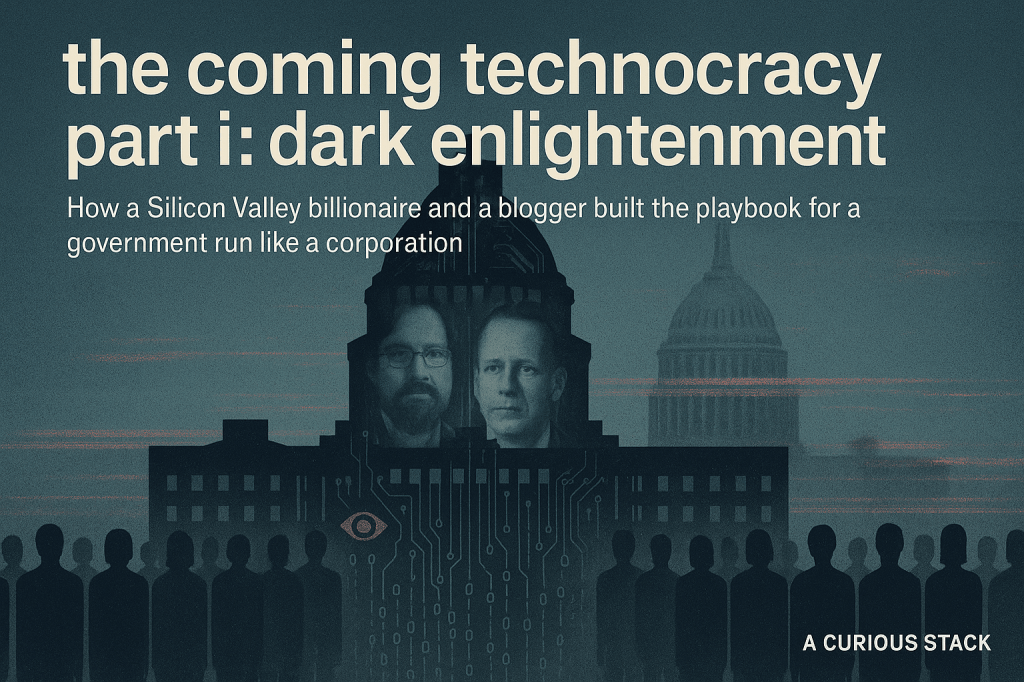
part I: dark enlightenment- the operating system of the new overlords
⸻
what is a technocracy? and why is it a threat?
A technocracy is a system of government in which decision-makers are selected based on their expertise in science, technology, engineering, or economics—rather than through democratic elections. In theory, it replaces political debate with evidence-based efficiency. In practice, it centralizes power into the hands of unelected specialists, corporate executives, and technical elites who operate outside of democratic accountability.
Technocracies are not inherently dystopian, but in their modern form—especially when fused with corporate interests and surveillance infrastructure—they become a vehicle for authoritarianism. The system rewards control, not consent. It replaces public deliberation with algorithmic governance. It turns citizens into data sets and elections into obsolete rituals.
In the context of the United States, the threat of a rising technocracy lies in its ability to hollow out democratic institutions from within, replacing them with privatized infrastructure, predictive policing, AI-led enforcement, and executive overreach. It takes the side streets to detour around the Constitution. The shift is slow, structural, and largely invisible until it’s already embedded in everyday life.
This series begins where that architecture starts to take shape: with the ideology fueling it.
⸻
the origins of the dark enlightenment
The term Dark Enlightenment was coined by British philosopher Nick Land, whose early work in accelerationist philosophy evolved into an explicitly reactionary political doctrine in the early 2000s. Land’s writings argue that liberal democracy, human rights, and egalitarianism are obstacles to human progress, and should be replaced with hierarchical, technocratic systems governed by elite rule and digital control.
The most influential voice within the movement, however, is American writer and software engineer Curtis Yarvin, who wrote under the pseudonym Mencius Moldbug. Yarvin began publishing long, densely argued blog posts that laid out a vision of what he called “neocameralism”—a form of government modeled on a joint-stock corporation. In this model, the state is run like a company, with a CEO (not a president), shareholders (not voters), and security forces (not public services).
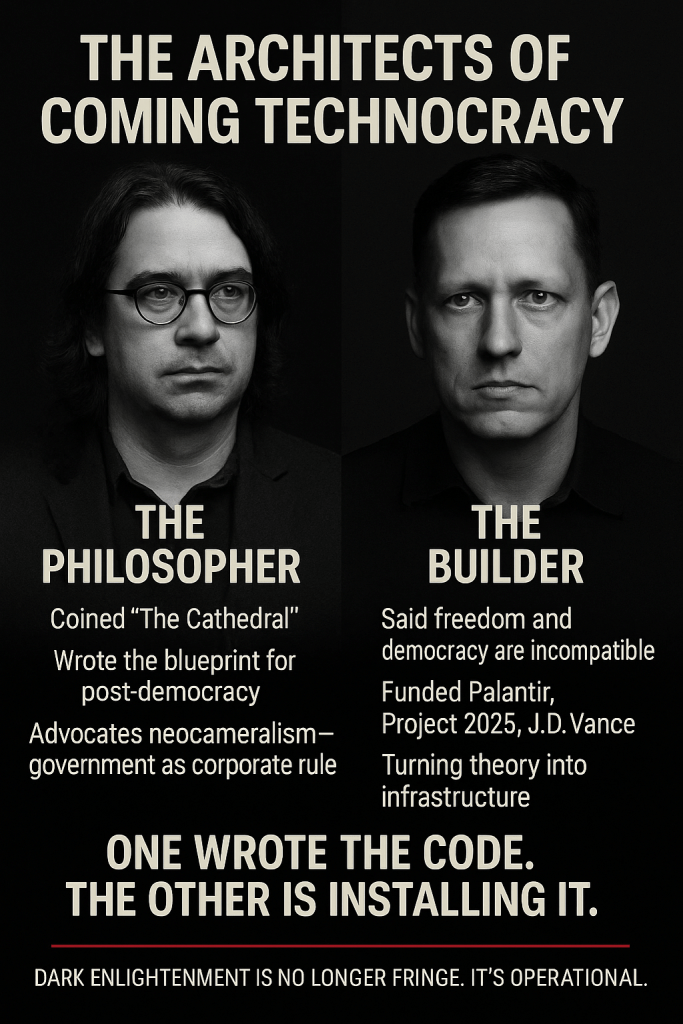
Yarvin is also responsible for the idea of “The Cathedral,” a term he coined to describe the informal alliance of universities, media, and bureaucratic institutions that promote what he sees as progressive orthodoxy. In his view, these institutions manufacture consensus and suppress dissent. His solution is radical: dismantle the Cathedral, abolish democracy, and restore hierarchical rule by a sovereign executive.
These writings have shaped real-world ideology among Silicon Valley investors, government reformers, and right-wing political operatives. And most alarmingly, they are being implemented.
⸻
peter thiel’s role: from capital to control
Peter Thiel, billionaire investor and co-founder of PayPal and Palantir Technologies, has become the most prominent public figure aligned with the ideas of the Dark Enlightenment. Thiel’s ideological leanings were made explicit in his 2009 essay The Education of a Libertarian, published through the libertarian think tank Cato Institute. In it, he states plainly:
“I no longer believe that freedom and democracy are compatible.”
—Peter Thiel, Cato Unbound, 2009
Thiel blames the failures of modern governance on two developments: the expansion of the welfare state and the extension of voting rights, which he claims have undermined the foundations of capitalism. Rather than propose reforms, he suggests abandoning the democratic model altogether in favor of startup societies, sovereign cities, and authoritarian administrative systems led by competent elites.
Thiel has been a long-time admirer and backer of Curtis Yarvin. He has invited Yarvin to speak at events and has echoed the core principles of neoreactionary philosophy in public and private settings. Yarvin himself has stated that Thiel is “fully enlightened”—a term used within NRx circles to describe someone who accepts the Dark Enlightenment’s central thesis.
Thiel’s political activity reflects this ideology. He has donated millions to far-right candidates who support authoritarian executive power, including J.D. Vance, Blake Masters, and Donald Trump. He has funded organizations aligned with Project 2025, a Heritage Foundation initiative designed to purge the federal bureaucracy and replace it with loyalist operatives who answer only to the president.
⸻
Palantir and the rise of predictive governance
Thiel’s worldview is most clearly expressed through Palantir Technologies, the data analytics company he co-founded in 2003. Palantir builds powerful predictive systems for law enforcement, immigration agencies, military contractors, and intelligence services. These systems are used not just to track behavior, but to forecast future threats, assign risk scores to individuals, and guide preemptive intervention.
According to reporting from The Daily Beast, Palantir’s Gotham platform was used by ICE to track and deport undocumented immigrants using massive data mining techniques. The company’s tools have been embedded in predictive policing programs in major cities, raising major concerns about racial profiling, civil liberties violations, and algorithmic bias.
These tools are built on the logic of pre-crime—assessing citizens not by what they’ve done, but what a machine calculates they might do.
In a democratic society, the state requires cause to investigate you. In a technocracy, your behavior is a dataset, and suspicion is calculated before you even act. When those predictions are fed into police departments, immigration offices, or defense agencies, the results are no longer theoretical—they’re enforced through handcuffs, drones, and surveillance grids.
This is the world Thiel is building through Palantir.
⸻
the technocratic threat to u.s. democracy
Dark Enlightenment is not merely a rejection of democracy. It’s also a functional justification for replacing it. In Yarvin’s vision—and in Thiel’s practice—consent is irrelevant. Power flows to those who build and manage the systems of control. This includes predictive policing, biometric surveillance, financial influence, and algorithmic manipulation of public opinion.
In a technocracy, elections still occur, but they become hollow rituals. The real power lies in the hands of unelected elites who design the infrastructure, write the software, and control the data. As public institutions are defunded, defanged, or dismantled entirely, private platforms and corporate rule step in to fill the vacuum.
Still think this is just a conspiracy theory? It’s already happening. Government services are being outsourced to Palantir. Civil servant positions are being targeted for purges under Project 2025. Laws are being shaped by donors, not constituents. Political power is being algorithmically optimized by think tanks backed by billionaires who publicly declare their disdain for democratic governance.
And the public has no access to the back end of the system.
⸻
conclusion: the reboot has already begun
The coming technocracy will not arrive with a military coup or a burning Constitution. It will arrive through software updates, platform policies, funding reallocations, and executive orders. It will claim to solve problems better, faster, and more efficiently than traditional government. And it will do so by cutting the public out of the process entirely.
Dark Enlightenment is the ideology guiding this transition. Its adherents do not believe in public accountability, human rights, or civic equality. They believe in control, hierarchy, and order. They believe the future belongs to the competent few—and that everyone else is noise.
Peter Thiel is not the only one with this vision.
The only way to resist a system is to name it. This is the name.
And remember to always
Stay curious.
Be safe.
⸻
sources
Peter Thiel’s “The Education of a Libertarian” – Cato Institute
Dark Enlightenment – Wikipedia
Cascade Institute: Dark Enlightenment Spread into Washington
The Daily Beast: Palantir’s Role in Predictive Policing and ICE
 A Curious Stack
Leave a comment